레이블이 Critical Essays 2022인 게시물을 표시합니다. 모든 게시물 표시


An Image as a Structure

Soyeon Ahn

I should start this writing with All this way to meet you (2022). The form, which combines metal chains and plastic clay, has two secret spaces. There is an inner space for bonding with each other between chains that have their own structural forms and clay that exists as a material, and there is an outer space created by the single form of the two joined together. Therefore, the title of the work “All this way to meet you” can also be comprehended with two meanings. You and I in the sentence can be identified as the two components that form a single sculpture, and it also could be portraying the relationship of looking and being seen between the sculpture and the body facing it. Anyhow, the two spaces, the two comprehensions, and the two gazes are simultaneously working together as they display secrecy amid strange tensions.
 
The metal chains exist as objects that cannot stand vertically because of their weight in reality or at present toward gravity, along with their volumeless surfaces. The clay firmly upholds any shape from the floor based on its underlying cohesive and coagulable abilities. The metal chains penetrate through the form and determine the scale, and the clay defines the volume that allows random shapes to have a direction of movement, like the muscles attached to the bone. Thus, the conditions of a sculpture are fulfilled. The sculpture at this time repeats perpetual conflicts and reconciliation between the impulse to induce waves of particles and the obligation to force particles to freeze. For example, the relationship between the chains and clay defines the sculpture's interior and exterior and propels the general perception and awareness regarding the form. However, it could be a twist between the two. In the areas where the bones are clearly exposed, the clay is permeated into the gaps of the chains and is clinging on, evoking the image of a precarious transition between the interior and exterior. This spatial overturn brings the sculpture to be perceived as an indication of an ongoing transformation rather than an already complete form.


All this way to meet you,
steel chain, plastic clay, acrylic paint, 80x67x47cm,
2022
 
One of the pieces from the same period, I grow when you fall (2022), also shares a similar sense. The combination of metal rods and resins has a very close resemblance to the sense revealed by the union of metal chains and clay in All this way to meet you. Thus, the two or more spaces that the two form inside and outside, the dual relationship between you and I encompassed in the title of the piece, and the gaze or the movement of the gaze that changes according to the relationship are once again repeated in I grow when you fall.
 
I have seen at least two figures standing facing each other on a diagonal drawn from two corners in the same space sharing a flat floor, specifically All this way to meet you and I grow when you fall. In the two-person exhibition with Mark Yang, Inanimatefy (2022, VSF), Jungyoon Hyen depicted a scene as if the two pieces were exchanging their respective lines, "All this way to meet you” and “I grow when you fall.” At the site, I got over you (2022) and I got over you (almost) (2022) were hung side by side on the wall like reliefs. If they were placed on the floor, they would have given off different motility. However, as they were hanging on the wall, the two seemed as if they were trying to declare the classifications of their own forms from the wall toward the inner space, or vice versa, while strongly expressing a sort of instantaneous force of condensation. By doing so, Hyen's sculptures take in the physical condition of the form and the contour on the surface as borders and push hands/bodies to extend in pursuit of signs of transformation toward the outside and the inside.


I grow when you fall,
steel, resin, silicone, silicone pigment, 60x134x66cm
2022
 
**
 
Hyen jumps into the imagination of space in a sculptural manner. Just as Gilles Deleuze traced the power and movement that mediate a kind of transition through Bacon's pictorial senses, including the relationship between forms and spaces, in Francis Bacon: The Logic of Sensation (Francis Bacon: Logique de la Sensation, 1981), Hyen constantly recalls the spatial situation in which certain shapes emerge through sculptural senses. Regarding these figures, Deleuze said, “Thus isolated, the Figure becomes an Image” and described the appearance of the images in Bacon's paintings as such figures as “the figure, which would move along the armature together with the pedestal.”[1] Georges Didi-Huberman describes figures as a comprehensive image, and he explains images in relation to the ghostly remnant, like fireflies.[2] The figures that emerged from Deleuze and Didi-Huberman's observations and converted subtly through Hyen's sculptures are a sort of image that implies the possibility of expanding to spatial imagination and the sense of division and overlap of time.

 
This is an old theme that she has dealt with in the form of video and installation in her work even before she newly recognized the sculptural sense through sculptural mediums and techniques. At the time, she pursued a way that combined time and space that can re-mediate the reality/present like a montage. As mentioned earlier, her recent sculpture pieces have combined media, forms, and narrativity (without descriptions) to be able to determine the dual/multiple relationships between individual components. Thus, they directly remind us of the sculptural senses that constantly re-mediate the remnant figures/images around forms.


(Left) I got over you (almost), steel, silicone, silicone pigment, 37x58x16cm, 2022
(Right) I got over you, steel, silicone, silicone pigment, 34x38x14cm, 2022
 
Therefore, I think I should wrap up this writing with All this way to meet you. The sculpture created by combining metal chains and clay is a kind of image that personifies objects and materials. Furthermore, it induces instant imagination about the two and brings out human figures. Thus, it opens up the inner and outer space around the piece. The object and the material are combined to bring out the figure that faces oneself, and there are unintended traces of countless lines in space and the borders created by them. Through the process of attempting to create indestructible images at such borders, it allows us to imagine the newly overlapped physical and abstract time and space, in other words, sculptural time and space. Its faint clue can be found in the unfinished pencil drawing on the empty wall of Hyen's studio.

[1] Deleuze, G. Francis Bacon: The Logic of Sensation; Francis Bacon: Logique de la Sensation (1981)
[2] Didi-Huberman, G. [2018]. Survival of the Fireflies [Mitchell, L. S., Trans.]. University of Minnesota Press. [Original work published 2009]
 

Striking a Strike

Wonhwa Yoon

When everything is going to work out sounds like a lie, when we are desperate for sayings like “our efforts are going to pay off” or “tomorrow will be a better day” as if they were beleaguered unbeliever's prayers, when our feelings swell up narcissistically like a boast at a drinking party, when we cannot choose a path between unconditionally working hard and doing nothing, we go on a strike. In the summer of 2020, I was doing research on the history of art strikes. If it had been a better time, that research might have been another book in a set of books along with the book on art labor. However, I would not have done such research in the first place if the situation had been any different. The reason why I actually looked up past strike cases at the time was that I wanted to learn how to strike. In the poorly concluded paper, I wrote,“If a strike is to cease working in order to be able to work properly, it can be compared to getting off work or vacation rather than bankruptcy or retirement. Of course, a strike is not a holiday! If everything is still the same when you return from leaving work, then the pause is meaningless. The strike is defying the order that defines work and taking a determined action, redefining work by oneself. So a strike is not about not working. In other words, you cannot stop working even when you go on a strike.”


dream pop Logo, 2022
 
There is something dubious about the idea that a strike is a productive interruption of work. Who gave the order that you have to deliver results even when you are not working? However, being involved in art actually means doing something else during your work time for other tasks. Art, if there is such a thing, occupies your time and bends your path like protesters. It already is sort of a strike in that it stops for a while to change lives, and I had to stop working once again to think about how such a moment operates and serves us. Striking a strike is not just about lifting the occupation, it is about questioning the life in which a strike becomes a job. The reason for the lengthy explanation is that I thought that Cha Ji Ryang's work could be seen as a striking technique. In fact, in Strike, Sync, he defined the record of his time as a “strike resume” that continues to be updated. It was unclear whether art was a means, a target, or a goal of a strike. From time to time, he gathered people and organized a form of small strikes or slowdowns refusing to be swept away by trends. These gatherings were virtual lifeboats to avoid being swallowed by the waves, but at best, they were fragile eggs that revealed only some of the outline of the rock. Maybe he just wanted to build a theater in a slightly different form each time and want us to become actors, viewers, and directors of our situation on our own accord. This is a way of escaping. However, it requires some imagination to paint the theater as a place of strikes. Will we be able to strike in our dreams?
 

Surfing,
Video installation, Dimensions variable,
2022

Still, I think I have no choice but to quit this job if I do not want to work on Sundays. Strike becoming a job means that you are unable to set the boundary for your work. Watching a series of video works in which the artist speaks silently is not work, but also work at the same time. When you are tired of one life, you lose the ability to evacuate to another life. More precisely, you can not escape from the situation where you are constantly being thrown out elsewhere. This is not an exception in a world where creative destruction is almost providential. The book that I was slowly translating in the fall of 2012, which eventually went unpublished, begins as follows. “A retreat of meaning. The social situation in which collective life programs are dismantled without the time for mankind to devise new life programs. I put my feet on the ground.” The last sentence is an idiom meaning “worldly-wise,” which can be rewritten as “standing on the ground on two feet,” and some dictionaries explain it as “not having unrealistic ideas”. However, the author of the book has worked all his life to rewrite his world as a transparent dream. Of course, he did a lot of other things, but I think he was unable to get away from the front of his desk. Ten years ago, I thought it was a strange form of curse. Now, I take it as a way of life. If I was to document the time in between, I think a more suitable title on the first page would be “A History of New and Invisible Overwork,” rather than “A History of Strikes.”


Only people who decided to leave, can see everything: Stray Birds,
Pigment print, 124.5x70cm,
2021
 
Over the past few years, Cha has been experimenting with several ways to tie the knot with time. This does not carve out the past from the present or preserve every moment. It seems that even understanding and giving meaning to past actions were not the final purpose. In the winter of 2019, he reconstructed a collection of data containing memories until now into an airplane-type multimedia theater. Then came another winter when the plane could not fly and we could not continue what we were doing. During this unexpected strike, he updated his theater and added several audiovisual tracks to create “an album” called Only Those Who Want to Leave Can See Everything which still seemed like a transportation device borrowing the form of records. Where can this song take us? For a while, he passed out a track from the album to people as if he was asking a question. The track titled Surfing functions as an interlude between dark hard-to-see spaces and light-filled spaces within the album but does not draw clear arrows. In an acoustic landscape that seems to be a mixture of the white noise of the plane weighing on your ears and the careless rattling of the train, you can see traces of the past vibrate like a fly sitting on the tip of a turntable needle. It is an illusion, but it would no longer be an illusion if you actually start moving along with that vibration. You can walk out of the scene if you want. In the forest of frequencies, the song opens up such crossroads.

The Juxtaposition Technique of Hacked Objects - according to Jihyun Jung's alien assembly/disassembly methods

Juri Cho 

The shape of objects assembled by the artist Jihyun Jung feels somewhat genuine. Although none of the elements seems natural at all, the assembly method feels like it could be a valid way somewhere because the materials and parts seem to be procurable within a few days through the lowest price search and the impression that you are probably going to see them again somewhere when the exhibition is over. However, the reality is that they are montages of things that do not exist anywhere. The alien completeness of the pieces, which seems to have been carefully made by someone who has never learned how to assemble them, throws us into confusion. Furthermore, they make us forget how to appreciate the object we define as “works.” There is confusion as to whether to look at the series of works wandering between “object sculptures” and “sculptural objects”as formative attempts, interpret them as a kind of performance through a sculptural experiment, or just consider them as marvelous inventions. However, what is more urgent than clearly defining Jung's pieces is finding a clue to get closer to the origin of the work and the reason behind them that even the artist might not have realized. We need to find it from her early and representative pieces from 2022 and their descriptions.
 

Teletubbies Installation view, 2022

"Hack”, the word that first came to my mind in examining the attitude and way of creating pieces, is the key to opening up the work for me. When you look into Jung's work style before simply accepting her official explanation, it seems like she is hacking ordinary objects used in everyday life in her own way. The word hack has negative connotations, such as stealing or interfering, but its exemplary meaning is to understand the structure and operating principles by decomposing machine structures, objects, and systems, and creating new structures and usages. This would be the same as the DIY assembly method that combines new items that are difficult to grasp with just intuition but can be quite useful to some, including household furniture, exercise equipment, various stands, and illuminators that can be purchased in the form of off-the-shelf products. In general, open-source hackers gradually create new forms and functions through the process of focusing on the analysis and decomposition of their targets, and they finally implement their independent creations and developments according to their own aesthetic logic.
 
However, Jung's sculptural methodology of assembling off-the-shelf products as ready-made objects is not completely new. It is also the legacy of Dadaists and Surrealists that has continued since the early 20th century. If a juxtaposition technique such as the“Beautiful as the chance encounter of a sewing machine and an umbrella on a dissection table,” a symbolic verse from the 19th-century poet Comte de Lautréamont's prose poem Les Chants de Maldoror, was the core methodology of literary aesthetics envisioned by Surrealists in the past, then we can say that today's artists are determined to go beyond the juxtaposition of objects that radiates“sporadic beauty” and reach post-artistic formation through active hacking and design combination of existence and objects. Although“coincidence of process” and“consequential beauty” are far from the goal of Jung's work, there is a distinct difference from classical formative work in that it does not presuppose transcendental values and the legitimacy of form from her formative practice and that it flattens the hierarchy between her pieces and objects with the same logic.


Mermaid,
Mixed media, 110x110x50cm,
2022
 
On the contrary, the series of works assembled and dismantled by Jung trigger an immediate psychological response. The sense of volume and structure of the device in contact with or connected to the body and the feeling of the foreign matter about the silhouette appear on various scales. Maybe it is a level of sensitivity difference that is intolerable to sensitive people's eyes, but acceptable in dull people's view. What is the reality of such uncomfortable emotions? Jung's works evoke the body. It is inevitable to not summon the classic Freud definition of“uncanny” in the face of the chilling sensation surrounding the place where someone lay in, sat on, draped on, leaned on, and gazed at. Things that have appeared at the wrong time and in the wrong place are bizarre. This is because they disturb the tranquility of real existence that is here now. They are large masses wrapped in black textiles, like shrouds, glistening with only their thin legs showing, and also iron equipment that cannot be distinguished between massage chairs, game chairs, or surgical chairs. They are in a state in which they are indistinguishable between lifelike or lifeless, main body or parts, and proliferated or concealed. Why did the artist become so immersed in making such uncanny masses?

Jung's work began with specific experiences and voluntary explorations of the relationship between digital devices and the body. As an artist that works with three-dimensional objects, she was interested in the sense of connection between smartphones, laptops, and various electronic devices, which are interfaces that directly come in contact with her body, and she focused on the unique formative and spatial gestalt generated between them. Like the artist's discovery, the body, digital devices, and peripherals that physically mediate between them connect like a single body and become an organic mass that transmits and receives data when power and Wi-Fi are secured. Otherwise, they are like senseless corpses like hosts that are blocked from each other. Considering the strong synchronization between analog bodies and digital content, such as eating while watching a mukbang and controlling the interval and breathing under the direction of running apps such as RunDay, we cannot disagree with the point. As a millennial artist, a generation that is physically and emotionally closely attached to electronic devices, the problematization process and formative response to this phenomenon have become the core of Jung's recently developed works. The hybrid combination method of diverse objects and everyday devices centered on various types of electrical and electronic equipment is a kind of an empty set to reveal the subjects' physical response and cognitive state in response to the designed space. Furthermore, it clearly shows the theatrical characteristics of sculptures. What are the senses and situations that people project into the sculptural space where the body has eluded? It might be an excessive dependence on electronic devices as the artist claims and its resulting sense of isolation, a different level of emotional attachment, or a sense of unconscious erotics and mutual amusement formed with machines. It depends on the psychological distance we have with her works and on the individual's experience and perception emanating from the pieces.

 
Training II,
Mixed media, 95x45x125cm,
2022

What was she trying to hack? Maybe it was the drowsy experience of unconsciously becoming one with all sorts of machinery devices, the moment of feeling fear and helplessness instead of feeling relieved being without electronics, or an indoor scene dominated by non-human objects and devices. While the landscape of things becomes our portrait, we attempt to erase the sense of familiarity one by one, overlap anxious things, and bond the starting points of objects and the tip of the body. In an ominous imagination, we try to hack into the external world and the inside of us, referring to Jihyun Jung's assembly and dismantling methods as guidelines.

Re-recognition of Frontality Recognizable within 0.3 Seconds: reinstalled/reset images from Hyelim Jun's work

Yuki Konno
 
What exactly is an image?
I received Hyelim Jun's work as images, and I contemplated how I would view them. As the artist said, paintings possess a frontality that can be recognized within 0.3 seconds. However, in this era, it is perfectly fine to use the term “images” interchangeably with “paintings.” Receiving records of exhibition overviews and individual photos of pieces as images and listening to explanations are not limited to Jun's works. In that case, can we consider Jun's attempt as a resistant attitude towards the fate called the image of painting? Can it be viewed as an attempt to oppose the pictorial conditions in the name of so-called sculptural painting or installation work? Several of Jun's pieces were spatially displayed at Index of six sides (Hapjungjigu, 2019) and The escape conditions of recursive maze (Post Territory Ujeongguk, 2020). Recently, she has attempted “plane-hedron,” not hexahedron. When you hear this, you might think that Jun pursues medium experiments between flat surfaces and three-dimensional structures through sculptural painting against the variable nature of images.
 
Before paying attention to media formats that conceptually seek trade-offs and extensions between flats and 3D, I would like to start from a more fundamental perspective. What kind of image was Jun's reproduction target? As she worked with materials, such as a scene from animation, landscapes, and images of paradise, how did she view them? The key point is that the frame defining the viewer's perspective or the image dismantles the connection between presented scenes and is reconstructed to show the emanated gap between them, instead of starting with images or data as visual information and pursuing physical properties/materialities. The aforementioned materials appear in a form of setup in the artist's series Shape of the gaze and Things, and the explanation can become simpler if we call them installation pieces because they can be considered as reinstallation attempts instead. They cannot be simply defined as data or image files. An ideal viewing condition is removed. The connection between the gaze of the steady perspective and the mobility that reduces the distance and presents them in front of our eyes, in other words, the connection between visual information and the viewer's position is detached.


Combined surfaces,
the picture of art space geumcheon open studio 6,
2022
 
Not an installation, but a reinstallation of perspectives and images
One step ahead of the media experiment that occurs in the process of moving from working on flat pieces to three-dimensional pieces, the artist already recognized distance, speed, and mobility in images. She had already found a clue to the frontality that can be recognized within 0.3 seconds from materials, such as views presented to you when you gaze at landscapes, a continuous and momentary scene from animation, and the beautiful and ideal paradise summoned in right front of your eyes. In order to contemplate this frontality, Jun reconstructs and dismantles the ideal view through her work. Her pieces can be considered as the result of capturing recognizable views as paintings even when they are separated or quickly passed by then re-presenting and reconstructing themselves in exhibition spaces. This is not the result of solving the conditions of painting with materials like thin and transparent cloth, the three-dimensional nature of the canvas, or human intervention. Reconstructing and dismantling the positions of images and viewers begins with the condition that the images already encompass the time and space differently and yet are in front of viewers' eyes. Paradises and landscapes have captured scenes that do not exist now or did not exist until now, and animations consist of countless drawn scenes.
 
The artist spatially re-created views. However, when the view is set or arranged through material compositions, it presents the frontality that can be recognized within 0.3 seconds. Moreover, it cracks spatiotemporal positions, which pull in viewers to be immersed in viewing. The crack was not created by contemplating the format or conditions of the medium for working on planar or solid pieces. It arose from questioning the form of painting that can be derived from dismantling and reconstructing the original time and space of the image that the artist worked with. We can change the artist's statement as follows; “A painting as a frontality in which images recognizable within 0.3 seconds can be returned.” Representing instantaneously appearing or have appeared images as paintings and breaking up that momentary appearances from the viewer's point of view form the basis of Jun's work. As a result, her pieces are spatial or three-dimensional, but they are different from media experiments that variably transform two-dimensional data into three-dimensional matters, and vice versa.
 

Combined surfaces,
the picture of art space geumcheon open studio 6,
2022

Hexahedron and plane-hedron: excess surface
We can fully review painting through the word hexahedron. Until now, painting experiments mentioned in art history have been sought toward the painting itself, such as the place of vanishing point that presents an illusory space, the space for self-criticizing flatness, and the space for an image where everything can be transferred to like the word “screen” suggests. Through the word, “hexahedron,” we can think about the relationship between the frame and the inner part of the painting. Paintings are not just simply flat and are not a space full of illusions. However, the word, “hexahedron,” leads to the conclusion that space also consists of surfaces when we look at them. The space in a painting, the space called painting, or where a painting is hung can only be seen as a surface to us, in other words, as an image. The attitude of only understanding that painting begins and ends on a surface or that a space is created only on a surface will end up in a vicious cycle of dimensions, so-called two-dimension and three-dimension.


Combined surfaces,
Canvas fabric on top of canvas frame, gesso, acrylic, Dimensions Variable,
2022

If Jun's past pieces have been emphasized by the nature of the motif itself, her new trials at “plane-hedron” focus more on the framework of paintings or so-called paintings. “Plane-hedron” is a result of the excessive surfaces of the word “hexahedron.” Until now, she has contemplated the painting's relationship between the flesh and the body, the part and the whole, the surface and the support, and the medium called painting through the surface, but now, she focuses more on the relationship with the foundation called painting, a body created by extra surfaces of plane-hedron. By drawing multiple supports, drawing on the back of the supports, or erecting crossed planes, what will the plane-hedron reveal? Starting from a plane, the “plane-hedron” reevaluates surfaces, bodies of paintings, supports, spaces in flat planes, and illusory places. 

Painting Contradicts Limits

 Somi Sim

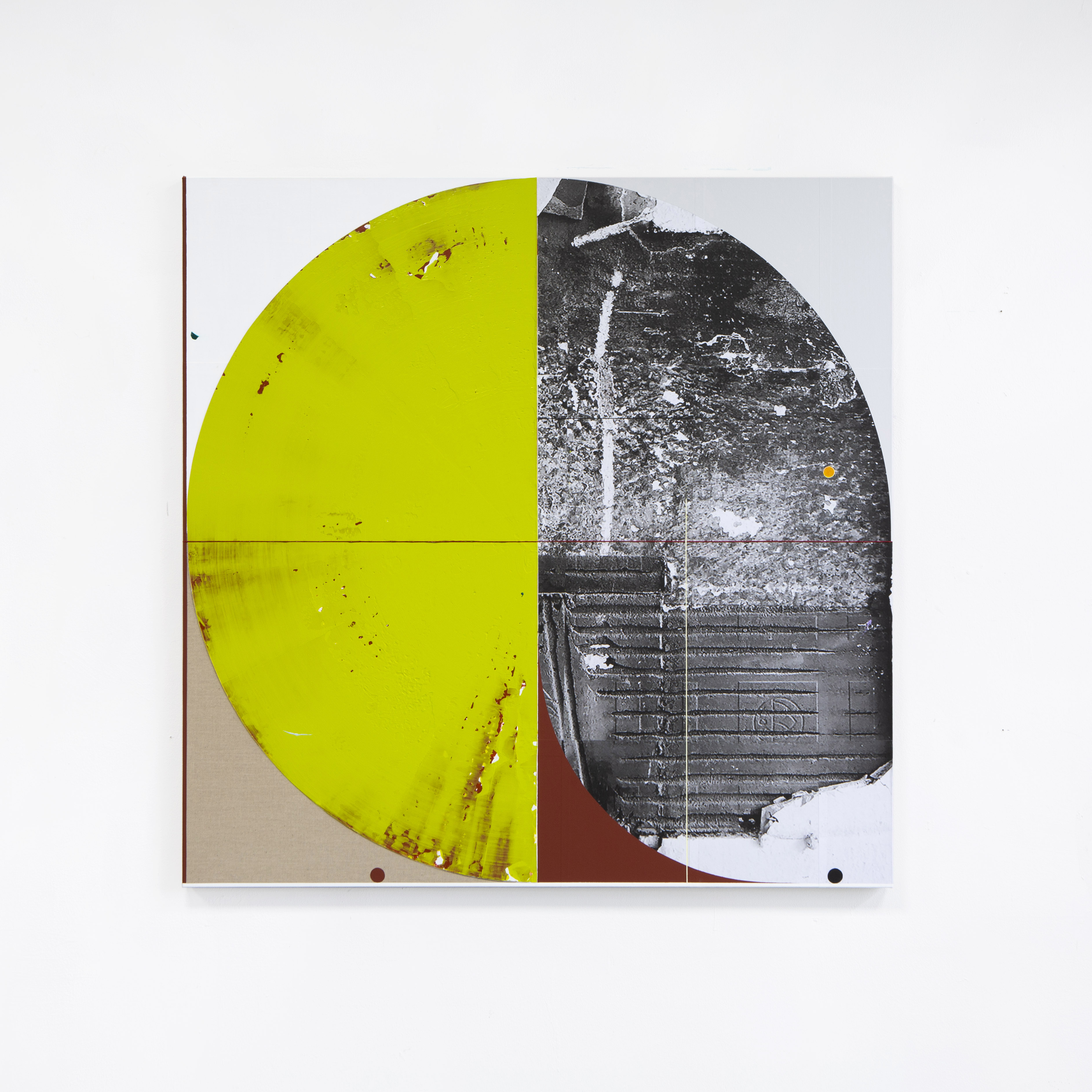
For Heejoon Lee, the conditions and limitations of painting are explored on the same level. In his paintings that have dealt with urban and architectural interests in the abstract language since 2016, the relationship between screen composition and quality has been maintained in an understated sense. The changes in such work style began with The Tourist in 2020 and were fully rendered in his solo exhibition Image Architect in 2021. On one hand, his former color plane abstract paintings have explored abstract languages with geometric compositions based on points, lines, and planes. Since then, his work has been pursued as a formal challenge within a frame by composing a pictorial plane in which images and paintings are juxtaposed through the photo collage method. The 2022 solo exhibition Heejoon Lee held in the following year expanded the formal experiments of painting to photography, sculpture, and spatial dimensions, including color plane abstractions, photo collages, and small three-dimensional pieces. Furthermore, the spatial installation work he introduced as the O.P.E.N. Project during the open studio of the Seoul Art Space Geumcheon (SASG) in 2022 has discovered the possibility of abstract language latent in material and space, reinterpreting the relationship between architectural elements and pictorial frames as a temporary variable space using felt cloth. His works, which span over various dimensions like the plane, three-dimension, and space, are basically based on the formal conditions of abstraction and aim to return the path to today's abstract thinking and practices to the frame of paintings. This writing attempts to approach the contemporary possibility of rediscovered abstraction by especially analyzing the recent full-fledged photo collage paintings, Image Architect series (2021-), from his plastic art experiments.


Salt, Palm, and Green, acrylic and photo-collage on canvas, 160x160cm, 2022
Reconstruction no.1-3, colored pencil and photo collage on paper, 15x15x15cm each, 2022
 
Unlike how contemporary paintings are seeking to break away from the canvas frame and make various formal variations, Lee has preferred to trap himself in the canvas's standardized frame. Moreover, the canvases that he usually uses are distinctively square and equally proportioned. These qualities delve into the conditions of flatness that deny the inflow of depth, perspective, and the illusion of the pictorial plane given by the vertically or horizontally long canvases. The square pictorial planes, which are usually 260×260cm, 160×160cm, or 45.5×45.5cm, are a basic framework reminiscent of the narrative and sense of absolute and intuitive abstraction contained in a square. The way he introduces images in the reductive frame of painting follows a formal experiment that gives fluidity and variability to the canvas by arranging thin two-dimensional planes of paper. If you take a closer look at his work, where acrylic paints and black-and-white photographs form one pictorial plane, you can see that the photographs are not attached as a single image and that they are actually filled with separate A4 paper. Depending on the size of the canvas, more than 100 sheets of A4 paper are attached, and this repeatedly aligned arrangement of black-and-white images is related to the process of reconstructing the frame of the images into the frame of the painting. This process of integrating canvas, paper, and ink leads to another support for painting that interacts with materials through the artist's physical intervention and repeated labor.


Mossy Terracotta,
acrylic and photo-collage on canvas, 100x100cm,
2022

Furthermore, when you take a close look at the relationship between the image formed on the pictorial plane and the painting, the printed photo images usually contain traces of the architecture photographed by the artist in his daily life. It focuses on the characteristics of the space left behind around the exhibition space that forms the art system or contains his delicate views on the form, shape, color, texture, and structure of buildings, such as the geometricality and the sensation of materials of common and ordinary architecture from his daily life as well as impressive architectures he came across during his travels. At this time, the totality of the black-and-white images printed section by section and attached is severely ruptured on the canvas, and the subtle error inside the image he intended in the arrangement is an element that breaks down the uniformity of form and perception. The pictorial traces on top of the piece created by the artist using a squeegee once again disrupt the illusion of a pixel-dominated space, evoking tension between imperfections and perfection on the pictorial plane while eliciting sensational order. In addition, the abstract language contained in points, lines, and planes causes the visual sense and memory dislocated from the image to form new information values. The composition and texture of architectural spaces and the cold nature of the digital image are converted into the experience of painting through the process of abstraction. At this time, the transition of experience is the process of experiencing the material dimension as the dimension of non-material (digital) images, then as the property of painting. The painting completed through this process inversely presents a path towards the experience of sensing three-dimensional space again from the strict frame conditions. The traces of the paintings formed in this manner not only intuitively adhere to the distant dimension's landscape of space on the pictorial plane, but also present the path of abstract language as a motivation to question the image recognition system familiar to contemporaries.


White Crema,
acrylic and photo-collage on canvas, 100x100cm,
2022

The transitions in Lee's recent paintings have been challenging the frame that previously defined painting through flexible channels such as the reinterpretation of image experiences through photo collages and a pictorial approach to decomposing digital images. Each time when he does, he questions the dominant order that established his paintings, and as a pictorial experiment that violates and contradicts them, he has actively introduced images, physical properties, and spatial elements as new materials. In his artist note he said,“I think in today's faster and clearer development, abstractions convey little information and unclear messages on the contrary.”The conditions of abstraction noted by the artist are attempted against the presence of excessive images, the specificity of flooding images, and the feed of unrecognizable image consumption in the digital society. His pictorial challenges, which exclusively possess the conditions of contemporary images, reconstruct the empirical dimensions of abstract language through the paradox inside the frame, while inheriting some of the solid formal conditions formed by the history of abstraction. Through such a series of processes of contrasting, dividing, and layering the dimensions of contemporary space and images, his paintings overcome the conditions and limits of the frame and open the door to the possibility and experience of abstraction attempted on the other side of the real-time image world.

New Technology, New Listening, New Angel

Taehyun Kwon

An incomprehensible voice continues. Words continue to pour out without subtitles, which slide back and forth between words and sounds. Occasionally, understandable sentences pop up amid murmurs. When poetic words such as “alive paper” are heard for a moment, one can doubt one's ears about its unfamiliar beauty. The meaning of the symbols uttered in this manner remains in the well of abstract sound. However, we can certainly tell that they are someone's words. We can tell that someone is intentionally arranging symbols and spewing them out of his mouth. The problem is the murmur. The meanings of his words are overlapping, smashing, and blurring. They are waves of abstract sounds that we can briefly focus on their meanings but are soon dissipated.
 
Maybe, someone might have been able to create subtitles for the interview by thoroughly analyzing the meaning of the speaker's words. However, Minsu Oh never added subtitles to them even when he presented such pieces multiple times. The problem of such overlapping boundaries between words and sounds itself is an important element of his convention. New Technology consists of the sound of such words, the image and sound of the rotary press that prints out the newspaper, and sometimes the mechanical installation outside the screen. Machines and a human are taking turns making sounds, and it sounds like a sort of dialogue in a way. Of course, it is not understandable.


New Technology: Run Start Common Neutral Ground, full ver. 2022,
Refrigerator, washing machine, vacuum, Bible, arduino, mixed media, dimensions variable,
18min interworking with video and machine (Run Start Common Neutral Ground),
Supported by the team 'Crip, Cribton', 2022
 

Amid the interchanging images and sounds of machines and humans, the video captures a wide range of areas in the factory where newspapers are printed from diverse viewpoints. Here, new technologies and the novelty of newspapers work paradoxically in many ways. Above all, newspapers are the least newest technology. You can rarely see people grabbing newspapers for breaking stories nowadays. People look at the world in real-time through the phone in their hands. As we ride the timelines of social media that pour data faster than the rapidly running rotary press, novelty to us is very different from how it was in the era of newspapers. The oldest media paradox in the name of new. If you look at the word Shinmun (新聞), which means newspaper in Korean, it can be translated literally into“hear new things,”as “shin” means new and “mun” means hear. What if we read the newspaper as if we were listening to\ new things? The challenge is to listen to New Technology that twists the sound of humans (words), machine noises, and sound works as something new. Then again, it overlaps all over again.
 
Sound is not the only abstract thing in New Technology. The video also shows scenes in which the camera is shaken by a hand or are extremely close-up. When capturing a printed newspaper, it fills the screen with extreme details to the point where you can see the texture of thin paper or the layers of printed CMYK dots. In addition, a huge rotary press operation continues to appear on the screen, and you will see an abstract screen that runs in one direction even when the rotary press is rapidly running and the printed newspapers are filling up the screen. Paul Virilio said that speed changes the shape of the world. What he means is that speed affects objects' likelihood of appearing or their forms. His argument that the acceleration of the world influenced the abstract paintings of contemporary art is interesting. We think of abstractions as creations of overlapping things that are too fast, too close, or too different.


New Technology, video ver. 2022, single channel video, 16min 17sec,
Commissioned by 2022 Seo-Seoul Museum of Art
Pre-opening Public Program Exceptional Times, Uncertain Moves,
2022

 
In addition, the installation work, which functions with the video of New Technology, the Bible spread out in single pages is illuminated with lights. The version screened at the Seo-Seoul Museum of Art's pre-opening program Exceptional Times, Uncertain Moves, the images of Bible pages illuminated with lights were inserted in the video. When you shine light on a thin piece of Bible paper, printed letters on the back of the clearly readable printed text suddenly pop forward and overlap. Thus, the Bible becomes the unreadable text, the tangled letters of the apostles, and the overlapping and murmuring voice of God.
 
In fact, texts are always written overlapped in such a manner. When we read a palimpsest over again, a reused parchment, we can always find a new constellation regardless of the linear time. The overlaps in the back of the text on the surface destroy both the texts on the front and the back, allowing them to be read new every time. Paul Klee's Angelus Novus, which Walter Benjamin introduces in his Theses on the Philosophy of History as he talks about the dialectical history that defies the progressing temporality, was created using a technique called the oil transfer method. When you apply oil paint on a sheet of paper placed on the floor and lay another sheet of paper on top of it and draw a picture on it, the oil is transferred to the back of the paper. Something overlaps once again in the transfer that goes back and forth on the paper. Paul Klee used this technique to portray an angel defying the progressing time with his back turned and looking back with his wings spread. It reminds us of something that the angel saves as he looks outside the picture plane and the power that stops the progressing world for a while as he spreads his wings.


Humans see light | 人は光を見る 2022 ver.2,
49 LCD monitor, motor, arduino, 20min interworking with video and machine,
Supported by the Seoul Art Space Geumcheon, 2022

 
We think about the strange symbiotic relationship between machines and humans that Minsu Oh points out in the world of overwhelmingly progressing new technologies. The world does not simply progress. We must focus our efforts on sensing machines and the invisible laborers that operate them. The problem is that we have to stop this ceaselessly moving world, but the point is that we can see and hear it. The constellation of overlaps created by Oh here meets the context outside his work. The Cargo Truckers Solidarity Union's strike is in full swing. In the chant of the union laborers, "Let's stop driving and change the world," we can think about the power of stopping again. It might be possible to overlap the declaration about the teleologically progressing time, instead of just the meaning of the strike. Furthermore, how does the newness of sporadic new technologies, new hearing, and new angels turn upside down? How does the back side come up forward? How does the oldest become the latest? What do we sense in the overlap between the audible and inaudible, readable and unreadable of New Technology? Would the paradox and abstraction rising from this dialectic be a kind of strike of aesthetic things?

Space for the “Minority”

Seojin Yim

Hip-hop music, meme, and ASCII art are elements that have been closely analyzed in the writings about Kwanghwee Ahn's work. They are genres or forms that are popularly familiar and they appear as the fundamental part of the artist’s work. In the music video, the language and image linked to the rap recited by the artist are put together in a distinctive manner. While this method of editing follows a normalized way of constructing audiovisual objects in the Internet era, it also constitutes the unique facade of his works. At the end of some of his music videos, the sources of the beats, images, and GIFs are specified, indicating that the work is an outcome of remixing various existing materials.

Ahn's reuse of the beat using DJing, mashup, and sampling as a methodology feels like a natural choice, considering that hip hop music at its early stage had not faced too many restrictions in relation to the notion of the author and originality. The term ‘remix,’ which encompasses the aforementioned methodology, began to spread as it was widely used in the field of popular music, and it is also an early distinct feature of hip hop and Internet visual culture, which are two main subjects linked to the artist's works. Today, the meaning of ‘remix’ goes beyond the scope of a simple technical method and it has been extended to indicate ‘remix culture,’ which is a term associated with a series of social movements that supports free reading and processing of information. The implications of ‘remix culture’ now have become prevalent to the extent that it constitutes today’s way of life that, in turn, establishes a dominant aesthetic in almost all areas. Using emojis, memojis, and GIFs that move brilliantly in sync with the music, Ahn utilizes the visual materials that we frequently encounter in our day-to-day technological environments. These characteristics may be reduced to familiarity, but his work may be viewed as an unexaggerated diagnosis and reenactment of today's visual environment.


Lenticular,
Lenticular, 130x90cm,
2022

Culture is bound to be gradually institutionalized, and distortion of initial intentions occurs after the institutionalization. Nowadays, highly commercialized hip hop music and its culture are consumed as images of gangster black men or hypersexualized black women. The use of watermarks and paywalls is spreading in the Internet environment. These are systems that are devised to accelerate the money-making in virtual spaces and they are becoming more intricate day by day. We must remember the starting point of both hip hop music and the Internet, and the fact that they have expanded their influence by advocating unrestricted access and exchange of given resources. Procedures to limit these early ideals have become structural and institutional practices, and the respective culture in two areas, hip hop and the Internet, is also taking such steps. Then, why is the artist exploring the two realms as the main devices of his work?

The answer is in the question just asked. Hip hop culture functions as a metaphor for the ideal worldview that Ahn wishes to introduce. Among them, block parties, which the artist mainly mentions, are symbolic to provide the spatial context of hip hop culture. Block parties were held mainly in Harlem and the Bronx area, where African-American populations are concentrated, and they were festivals where neighbors of all ages could participate in. Hip hop music was first born in the form of live performances, such as gatherings in the streets or empty lots playing music on turntables and break dancing to the music. The scenery of a block party, which would have been full of people dancing and talking, was different from the image of a slum that we easily think of in connection with the Harlem area. Ahn's interest in block parties lies in the power of transforming a place from a space of poverty to a space of connection, and from a space of individual isolation to a space of community. Regarding the effect of the power, the artist has expressed that,“Black people in Harlem have become awakened as a political group.”This is an interpretation mindful of the institutional function and ideal possibility of a block party that could form communities and groups. With such a point of view, for the artist, each of his exhibitions has the same meaning as an invitation to a block party.


Infinite Tagging,
Single-channel video(color), Loop,
2022

In his work titled The Pathetic Studio of The Pathetic Label (2022) presented at the Seoul Art Space Geumcheon (SASG) Open Studio in 2022, Ahn introduces a new system. He adopts the system of a label studio like he did previously with that of a block party. The project is to create a studio or a hideout space of a label consisting of three virtual members. In this space, a computer station where you can enjoy Ahn's rap music, graffiti, lenticular goods printed with lyrics, and a large portrait of the three virtual members are displayed—some on the wall, some on the floor. Given that this office space constructed by the artist is a space that accommodates relatively homogeneous members, instead of randomly gathered people, the demographic of the potential invitees to this space is more specific and straightforward than block parties. In other words, the setting of the label studio is a condition that increases the specificity of the entity who may become a part of the community. These settings half close the space that was open indefinitely when the exhibition space was set as a space corresponding to a block party. This measure could also be interpreted as a minimum device to be able to call on the industry and the group that share similar tastes or interests in a more direct manner.

Considering the physical space of the SASG, instead of the virtual setting of the label studio, this is a space where only the art professionals such as artists, curators, critics, and administrators would gather with a high probability. Moreover, visitors during the open studio period may belong to a narrower demographic due to the additional filter of being an affiliate or an acquaintance of an affiliate. The artist's word that this narrower group of people may be called a “minority group” makes us look at the group from a completely different perspective. This is comparable to the implication about a smaller group that often paints a picture in our mind of a privileged group. Ahn wants to evoke a collective experience within this spatial bracket where you are viewing the exhibition and reading the text, even though he knows that the identity of an artist is a difficult condition to be bounded within a single scope.


Lenticular,
2-channel video projection (color, 5-channel sound), 2min 12sec,
2022

In addition to promoting collective awakenings, the block party played a role in liberating the individual from the tension that fills a racialized space. Then, could Ahn’s invitation of the “minority”—artists or art professionals—to the virtual studio space also lead to liberating a group of people? If so, what could they be liberated from? What could be possible beyond the sense of liberation and efficacy that result from occupying a space? In order to proceed to the next step, it is necessary to turn our attention to the lyrics of the music created by the artist. His music already exists in all public realms that he was able to find, including exhibitions, catalogues, and online platforms. 

The Right to be Here, the Monument to Save Today

Woo Hyunjung

A monument is a public sculpture built to honor a person or event. Most of them are signs of the nation's historical achievements, but on the contrary, they are also used as an important symbol in the rituals of reflection on not repeating past mistakes or following great sacrifices. The lesson of the monument is significant when it rescues the present from failure or at least delaying the failure, regardless of the success or failure of the past it has endured. In other words, the monument presupposes failure. Then, what kind of present was Sunghyeop Seo's Monument built on top of?


Topological Sense,
plywood stained with ink, motor, wooden marbles, mixed media,
240x300x300cm (Engineering Design_ARSIO),
2020
 
Ink-painted plywood was used as the main material for the 250-centimeter-high sculpture and was constructed by connecting Doric columns, one of the Greek-Roman architectural styles, with tetrapods that can be easily found around the breakwater. Overall, it follows the form of a tetrapod, but the upper part of the Doric column is transformed at the tip of the four legs to make a passage for the sound to flow back and forth. The two objects that make up this monument are typical things selected by the artist, and the two are the representatives of two worlds with very different properties because they have no point of contact in their origin, characteristic, or purpose. The meeting of two different beings leads to misunderstanding, alienation, and disconnection, and this is the reality underneath Seo's Monument. The same goes for the low narration flowing around the Monument and the strange languages that are written on the top pillar of the tetrapod. The story that is written in Polish consists of the episodes of mistranslation that occur when different cultures collide and the loopholes in stereotypes. The slight conversations between the artist and those who are close to him are things that would make you giggle and smirk. However, minor events that will enrich someone's life begin to ask about the individual's position in the social class as they are ignited by words (narrations) and writings (texts) within the Monument.


Gosu Paravan,
plywood stained with ink, drum, motor, arduino, speaker,
120x60x49cm (Engineering Design_ARSIO),
2021
 
The Monument is a being that moves away from the two objects that gave birth to it and floats out of orbit while losing its function. It cannot support or block something while staying in a place that is not a temple or an ocean. Due to such placelessness, the Monument could be easily pushed out of society and is difficult to be recognized. We are ungenerous at giving complete space because we believe that the act of welcoming and embracing new human and non-human members is only natural. (Let us think about the difference between refugees and tourists. The alienation of radical figures or hybrid objects is also the same case.) How it is received in reality is still important, and recognizing others becomes the cornerstone of acquiring my space. In that sense, the unfamiliar appearance of the Monument and the out-of-the-way style of conversation are disturbing and dangerous. Something that cracks familiar landscapes cannot be welcomed easily. The courage of creating a new place while claiming the right to be here is a gesture that makes someone uncomfortable. The Monument is a device that prevents concepts, such as freedom, equality, and tolerance, from becoming abstracted and is an anchor that holds them in place so that they are not scattered in the air by false declarations. In order for the present to not fail, more objects like the Monument are needed. The Monument testifies through its existence that you should not become used to the language, power, relationship, and structure that support reality. What it insists is to be aware of the fact that someone's existence itself might be denied while you are paying close attention to someone's promise that your rights will be securely protected.


Monument,
plywood stained with ink, gold pigment, 250x245x275cm,
2022
 
The Monument says firmly, yet softly, “My place is here.” Even when you do not raise your voice or be upset, it shows its existence. In order to grasp the speech style of the Monument, I would like to look again into the two objects that gave birth to it. The columns and tetrapods have stable proportions, but they are rarely used alone. They are part of the whole, and what they have in common is that they require different beings. In order to function properly, they have to be shoulder-to-shoulder with their resemblances. This reveals the interdependence of objects that no being can be alone. This is the strategy of how Seo's Monument saves today differently from other monuments. It has to be the one that makes its place, and it looks around while letting others know that it does not need someone's approval. Sometimes, it reaches out to them while showing its inability. The union of western columns and tetrapods is a solidarity of those left alone and a welcoming greeting for a new existence.
 

Reference
Hyunkyung Kim, People, Place, Hospitality, Moonji Publishing, 2015
Hiroki Azuma (translated by Cheon An), Philosophy of the Tourist, Luciole, 2020