레이블이 Experiences인 게시물을 표시합니다. 모든 게시물 표시

Week in Review: Residency in Seoul, South Korea, Part 2
October 26, 2011
By Kristin Juárez

Photo by Kristin Juarez.
A few works stood out during the second week of my residency in Seoul.
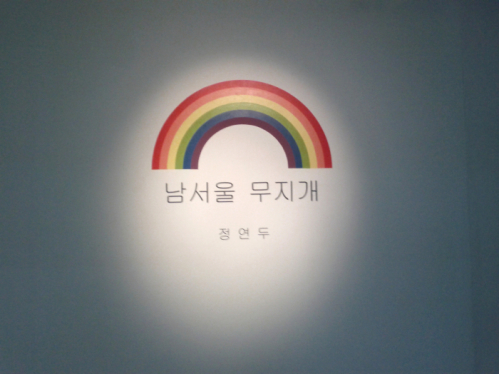
Artist Yeondoo Jung opened his exhibition, Southern Rainbow Seoul, here at Seoul Art Space Geumcheon (SASG). The result of a call for participants, the show is a series of portraits of individuals and families living in the apartment complex called Southern Rainbow Seoul. Asking people to open up their homes, Jung and exhibition-goers gain a glimpse into the private sphere through the lives of some of the building’s inhabitants. Together, the photographs act as a commentary on living conditions and the growing popularity of apartments (land is critical in Seoul), as well as a look into how people represent themselves. Promising a free photograph for their time, Jung gave the sitters little direction for how they should pose, leaving it up them to compose their portraits.
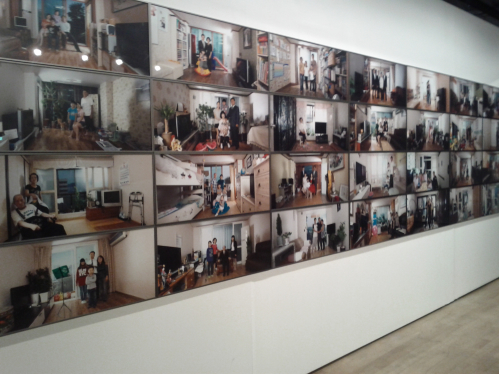
Photo by Kristin Juarez.
I was introduced to artist Ahn Doo Jin, an artist who works in painting and installation. Referencing the terror and sublime awe of historical landscapes and religious iconography, Ahn’s monumental work fuses his imagination with history. His bold, intricate works reveal a contemporary expression of the terror and awe of nature, and humanity’s place within nature. His paintings and installations engulf the viewer using visual perspective to promote a reconsideration of perspective in one’s life. Through his saturated color palette and imaginary settings, Ahn offers an escape from the trappings of reality and a platform for contemplation.
For the 2011 Incheon Women Artists’ Biennale, the theme Terra Incognita is meant to probe the status of the world as we know it, bringing into light artistic exploration of parallel universes. Works in the main exhibition (there are three other satellite exhibitions) move across a range of possible meanings, challenging the boundaries of outer/cyber/public/personal space. As a result, the art’s content expressed individual and collective identity, from the intimacy of family, to the borders dividing ethnic groups, to the ever-expansive scale of outer space.
The main exhibition included works by Yoko Ono, Yael Bartana, Joan Jonas, and Wangechi Mutu. LaToya Ruby Frazier is one artist whose work gave a richer meaning to the theme of parallel universes. Her video and photography work is set in Braddock, Pennsylvania—her hometown—and it documents her family through three generations of women living in a former steel-mill town. Working in collaboration with her mother, Frazier creates a family portrait that depicts a larger collective reality for many in Braddock. Her work is present in both the main exhibition and the satellite exhibition, Tuning.
While the main exhibition does not deliberately highlight the biennale as a site for women’s art, Tuning seeks to insert critical thought into the exhibition. More to come after I visit Tuning.
Another show, After Humanism at Alternative Art Space Loop, includes a video work, My Voice Would Reach You, by Japanese artist Meiro Koizumi. The video focuses on a man having a circular, heart-wrenching conversation over the phone with someone who, at first, you think is his mother. We don’t hear the voice on the other line. Perhaps she is suffering from an illness like dementia? Then, we come to realize that he is in fact speaking with various telephone operators. Koizumi constructs a highly emotional scene for the viewer to experience, and then shows us the construction of the scene, illuminating our own projections onto his work. The artist throws his formal strategies—the actor, the music, the script, the editing—into the spotlight, showing the tools he employed to create the viewer’s emotional connection to the work.
The exhibition at Sangsangmadang, Goodmoney, takes a look at socially engaged creative practices, including documentation of a TOMS shoe-drop in South Korea and a prototype for a $300 house. The show includes a video documenting social interventions by Eva Jung entitled The Samples of Emotions (Chinatown, New York). Setting up a modest meeting spot on the street and at markets, Jung invited participants to share a story of either happiness or sadness in exchange for a gift that represents the opposite emotion. The gift, a small bundle of pink plastic and tissue paper, is a small gesture that encapsulates the emotion.
Jung’s video shows the transformation that occurs through this act of storytelling. It begins with people sitting down with a certain amount of amusement and curiosity. For those who “give” sadness, we watch as their body language and facial expressions change with their personal stories. Though we are not able to hear the stories, it provokes empathy as the viewer projects their own stories onto the participants. The small action of giving the bundle, which Jung first splits to reveal the colorful inside, is a moment of visible catharsis for the participants. Viewers only learn at the ending credits what some of the stories were. Since you can’t put a face to these stories, you are once again asked to imagine and empathize with a stranger.
Kristin Juárez is the author of our monthly column, The Fringe, and is conducting a residency in Seoul, South Korea, through October 28, 2011. Click here to read Seoul Residency, Part 1.

* the article has quoted from
http://www.burnaway.org/2011/10/week-in-review-residency-in-seoul-south-korea-part-2/
The Fringe: Seoul Art Space Geumcheon Residency, Part 1

October 12, 2011
By Kristin Juárez

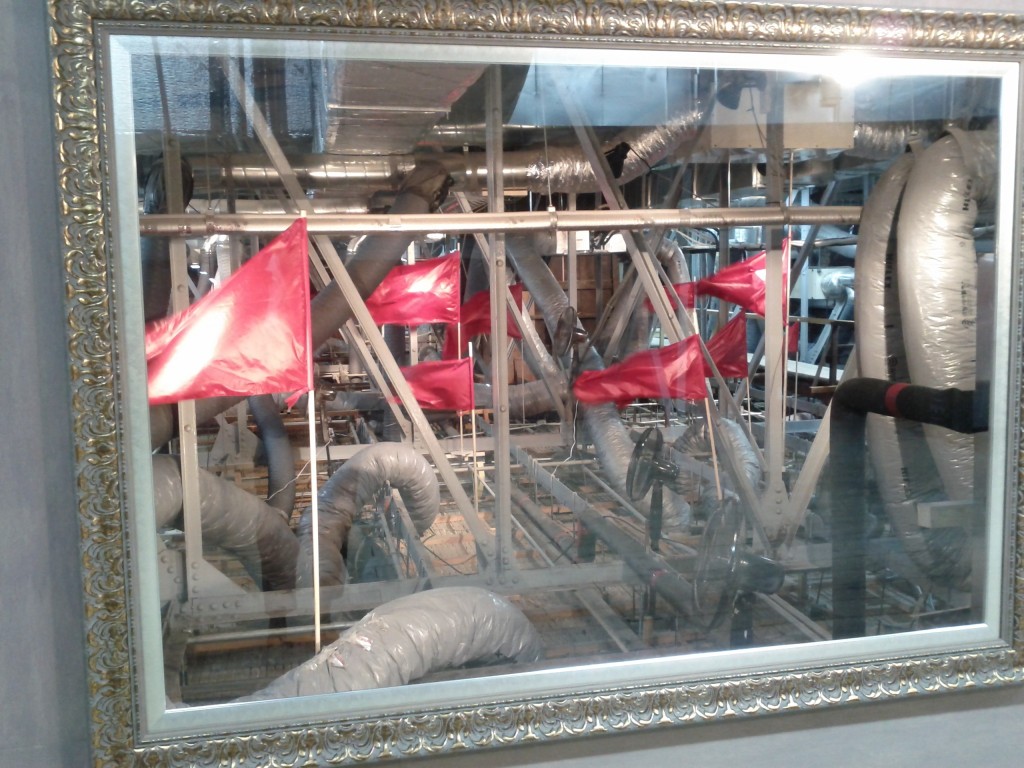
Kye-Ryoon Han, Flag, 2011, at Culture Station Seoul 284, dimensions and materials vary. Photo by Kristin Juarez.

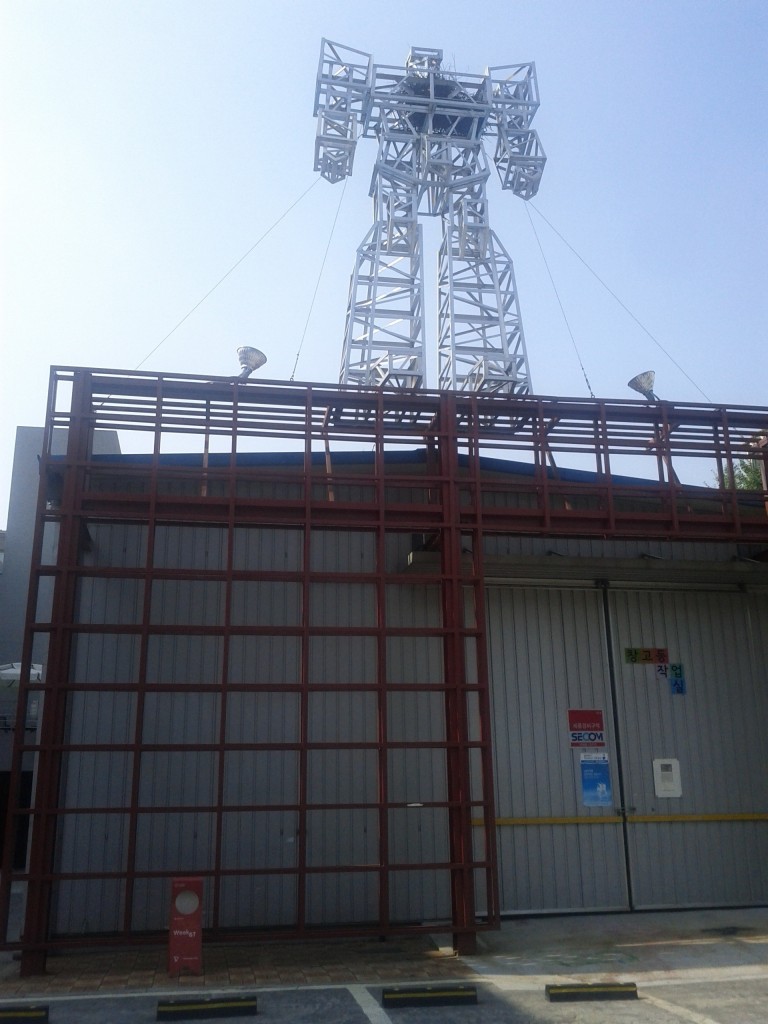
Annyeong Haseyo y’all. I’ve landed in Seoul, South Korea for a one-month art criticism residency at Seoul Art Space Geumcheon (SASG). SASG is a city-funded international artist residency program and studio space for local artists. Established in 2009, the art space transformed a former printing factory into a center for interdisciplinary experimentation and community art projects, offering one example of an urban area revitalized through the cultivation of the arts. Currently sharing the space are six international artists in residency, along with a collection of Korean artists. (Some of them are building a robot as I write this). There will be more to come on the artists who are here and their upcoming shows in the city in future articles. But first some initial impressions of a few art spaces I’ve visited.


A view of the exterior of Seoul Art Space Guemcheon, my host institution. Photo by Kristin Juárez.
I began my exploration of Seoul’s art scene by heading to Culture Station Seoul 284, a train hub turned art space. Gearing up for its big opening, a group of artists were working on the Countdown project, an evolving exhibition, lecture, and performance series created to engage with the time and space of the retired rail terminal. Originally built in 1925 as the city’s central train station, the Culture Station Seoul 284 takes the number in its title from its historically issued site number. Expanded in size, the current Seoul Station is only steps away and is comparable in activity to New York’s Grand Central Station. Standing as concurrent representations of past and present, the plaza that physically connects the two spaces presents a socially liminal space, where men line up for free services, and others, hard on their luck, take reprieve on the steps (or in the case of one man, smack dab in the middle of the plaza).

Cho Duck Hyun, Metaphor, 2011, at Culture Station Seoul 284, various materials and dimensions. Photo by Kristin Juárez.
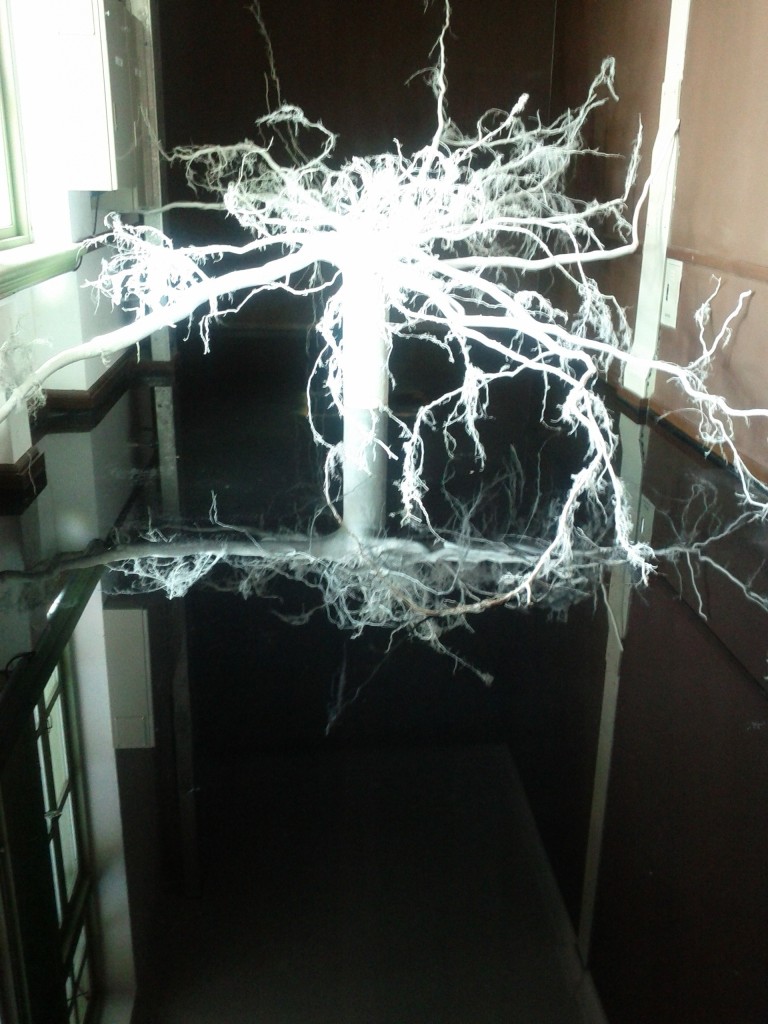
Inside Culture Station Seoul 284, Countdown demonstrates the kind of site specificity where form is dictated by the space an artwork inhabits. Encouraging small moments of discovery, many of the works offer an engaging bit of whimsy: a glowing tree emerges from a mysteriously dark pond in a small corner room, while the attic features a collection of flags waving in the air generated within the space. The nine-channel video installation Mansin by Chan-Kyong Park creates a more nuanced relationship between the physical site and its content. Situated in the station’s former women’s waiting room, Mansin intertwines storytelling and performance to reflect the role of women in Korean history, specifically their position in rituals, mythology, and spirituality.
Later, I headed down to a performing arts district to catch the Hello performance—a live public dance and screen project, called Large Screens and the Transnational Public Sphere, produced as a public art collaboration between Seoul and Melbourne. This year marks an official year of friendship between the two countries, and to celebrate, the project uses Skype to teach one another a new dance. Described as a continuously evolving dance routine, movements are passed back and forth in real time between participants in Melbourne and Seoul over the course of an hour. In an exchange that resembles the telephone game, participants learn what they can and then teach what they remember to the next participant in the other country.

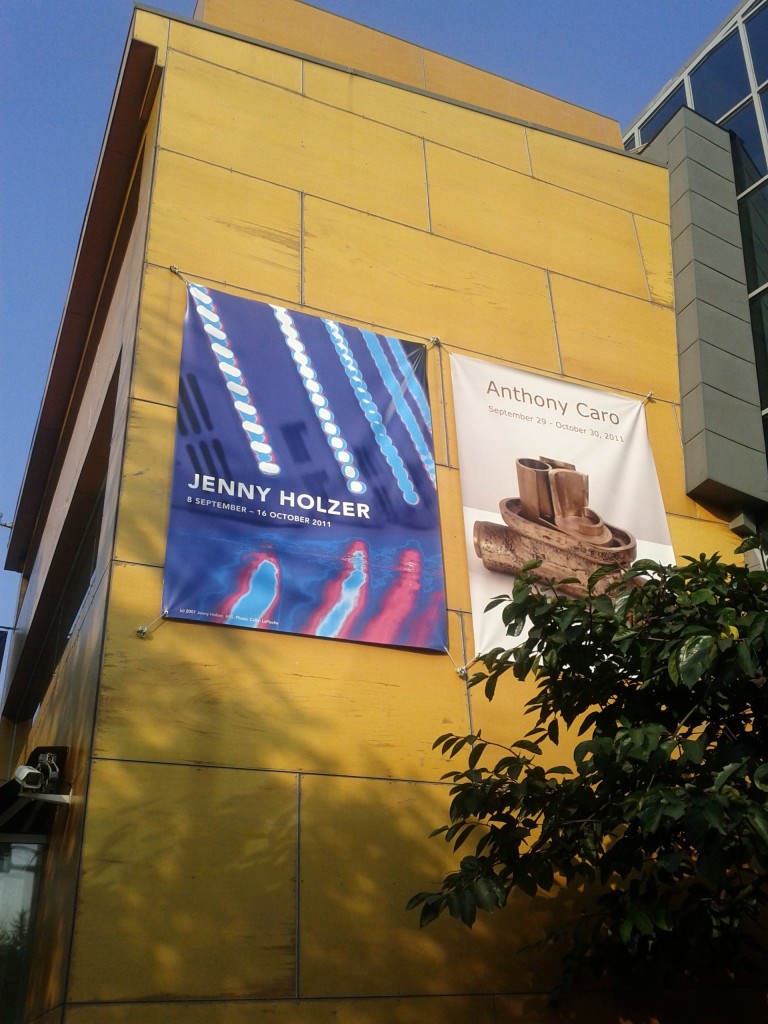
Jenny Holzer at Kukje Gallery. Photo by Kristin Juárez.
The next day I met with artist JuYoung Ban, a friend of Atlanta artist Gyun Hur, in Insadong, an area composed in part of traditional houses and shops and contemporary art galleries and boutiques. Across from this district’s historical palace sits Gallery Hyundai where artists have taken up residency in a storefront to DJ, fly fish, camp, and draw. Further down the street at Kumho Museum of Art, a photography show titled Cross-scape exhibits the diverse aspects of Asian culture through works from eleven Southeast Asian countries. Meanwhile, Kukje Gallery is showing a selection of works by Jenny Holzer, including prints of her iconic projections onto architecture, inscribed marble benches, and LED signs constructed into structural forms. The last place we visited was Artsonje, a contemporary art space dedicated to driving a dialogue about contemporary art in Seoul. Currently on display is an extensive retrospective of drawings, called Lines of Flight, by the internationally acclaimed Korean artist, Yiso Bahc. Bahc is credited with introducing postmodern art theory to the Korean art scene. And with nearly two hundred drawings and early paintings, the show provides a glimpse at the artist’s process and the development of his work and interests.
I am beginning to learn about the city and its politics of space as a rapidly growing metropolis. Though Seoul and Atlanta can’t necessarily be described as analogous cities, there are threads that do connect the two; they just articulate themselves in dramatically different ways: In Seoul, the ever-present railroads are used to transport people not goods, and the old buildings that are repurposed into art spaces are managed by the government not artists, but in case I felt too far from home the nearby Coca-Cola plant acts as a reminder. During my month here, my plan includes visits to artist studios, two biennials, and all the art spaces I can find. Stay tuned for more updates.
Kristin Juárez will be in Seoul, South Korea through October 28, 2011. Click here to read Seoul Residency, Part 2.
In her monthly column, The Fringe, Kristin Juárez writes on the intersections of art and the public sphere. She emphasizes art as a vehicle for visualizing social, environmental, and political issues pertinent to our lives both in Atlanta and abroad. This column traces her exploration of interdisciplinary practices that continue to reflect, foster, or challenge contemporary notions of collective identity.
Check BURNAWAY to read The Fringe on the second Wednesday of every month.


* the article has quoted from
http://www.burnaway.org/2011/10/the-fringe-seoul-residency-part-1/

I first heard about Seoul Art Space Geumcheon (SASG) from a fellow curator who recommended the new curatorial residency as I was looking for a location in South Korea to conduct research. Upon arriving at the space which is housed in a recently renovated factory complete with an adjacent warehouse, I was impressed at the extensive facilities provided to the residents that included a new media lab, a lecture room that can be used for presentations or screenings, a gallery on the top floor, and the large warehouse that doubles as a workshop with a wide range of machines that can also be utilized as an exhibition space.


The diverse inhabitants at the residency were composed of a mixture of international artists and Korean artists. Together they formed a critical community that was primarily engaged in the ongoing social, political and economic transformations.


A large kitchen shared by the all of the residents was a central meeting point for sharing a conversation, coffee or meal. The complex also had a number of other common areas which provide a variety of spaces to meet. The staff works onsite and was always very helpful and attentive to the needs of the residents. While I was there they also invited me to a number of museum and gallery openings, and provided numerous introductions to assist me in my research.


The artists' studios are spacious and international residents are provided with both a room and a separate studio. The accommodation for curators consist of a live – in studio which is modest but ample.


SASG is located in a mixed industrial and residential neighborhood that at one time was a center for small-scale manufacturing. I found most basic necissities were a short walk away. Accessing the rest of Seoul is easy as there are two metro lines close to the center.


Overall my stay at SASG was a memorable and productive experience. The staff and the artistic practices that converge at the space make this one of the most interesting residencies in Asia.


────


Jason Waite is an independent curator and writer. He was the co-curator of the 4th Young Artists’ Biennial in Bucharest and the founder of the nomadic exhibition, the International Guerrilla Video Festival, that aims to integrate art into the urban social landscape. Previously, he has worked with the Solomon R. Guggenheim Museum in New York, Cittadellarte-Fondazione Pistoletto, Italy and Independent Curators International, New York and has contributed to a number of catalogues and magazines. He holds an MA in Art and Politics from Goldsmiths College, University of London.


Selected Projects:

2011 Producing Censorship, New York, Invisible Dog & Milan, Fabbrica del Vapore
2011 State of Unrest: Northern Iraq, London, no.w.here.
2010 4th Biennial of Young Artists – Police the Police, Bucharest
2009 International Guerrilla Video Festival, Dublin
2008 International Guerrilla Video Festival, Milan

How did you find working at SASG?
At the moment I am 4 ½ weeks in Seoul Art Space Geumcheon. The second day of my stay I had to start already working for a group exhibition/collaborrative project at the Brain Factory Gallery that opened ten days later. (so, no time for jetlag.) This was a good and fast introduction to Art Space Geumcheon, and to the other artists, and to Korea in general. I worked in the warehouse with a carpenter that we hired and had to find my way in the Geumcheon area very fast to find materials, tools etc. I find the warehouse spacious and well equipped for working. The first three and a half week of my stay were filled with (too) many events and appointments, so many that I almost had no time to work in my studio. This week I was able to spend a few days my studio without being interrupted. I feel that time is running fast and I prefer to have some quality studio time the next days to write and think. I like my studio, it’s spacious and light. I also enjoy living together and interact with the other artists, both Korean and foreign artists. I would appreciate it very much if there would be a clear monthly agenda in English in advance for the meetings, events, lectures etc. in order to plan my own appointments etc. I have to get used to the ‘size’ of the city of Seoul: distances are quite big and sometimes it takes hours, or half a day to buy something in a shop on the other side of town. That makes precious time running very fast. But it’s also interesting, on the way to the shop there is always a lot to see and discover..

2. How was living at SASG, compared to other international residencies?
The residency is well kept, well equipped and the atmosphere among artists is friendly and good, staff is helpful.

3. Did residencing at SASG effected your work? If so, how?
I think it is not exactly living in the Geumcheon area that effects my work at this moment, but it’s more living in Seoul in that effects my work in the first place. Let’s say it’s too early to be effected by the area already, it’s the culture of Korea in general that is inspiring for me at the moment.
1. How did you find working at SASG?

It is great to have a studio and I really enjoy working in my studio every day. I go to the hostel just for sleep. For me, this is a luxury since space in New York is very limited and I only have one room for everything. I am making the most of my space here and making installations in the studio with video and sound, photographs, and loudspeakers.

Since I arrived I have been waking up around 9AM (sometimes much earlier) to begin work. I am taking full advantage of my studio space and the available equipment. I feel that I am growing as an artist here.

I am also aware of our position in the community. I am very sensitive to how people are in this neighborhood. I have enjoyed engaging with the public with my Sound Workshop and Free Improvisation Session and studio visits from many students of all ages. It is really interesting to see how people react to my work. I feel that I am speaking about the neighborhood and Seoul at large in my work. I hope that it resonates with people here.

The workshop I presented was interesting for me since I have never taught students of that age before.
The classes that I taught before were at the university level. The young people are very interested and inspired by the simplest things—things that I take for granted. I hope that my Sound Workshop was inspiring to them and that it might make them think about their environment. I believe that some people in this neighborhood were not familiar with the kazoo. I would like to think that I might have inspired some of them to become musicians through the toy music instrument jam where we played "music" with kazoos, castanets, rhythm sticks, percussion eggs and cymbals.

Also, accompanying Hueng Soon Im to the public library screening and concert event in northeast Seoul in Gang-Seo Gu made me realize that young people have so much enthusiasm for music. The kids provided a wonderful rhythm section. I was really touched by how open they were to anything that I could teach them. They were really looking up to me and I enjoyed showing them the guitar and how to make chords. One of the young people was playing guitar in no time! I wonder if she will be a musician some day?

When my collaborator Kenya Kawaguchi was here we were unable to do a performance at Seoul Art Space due to a projected disinterest from the public from our manager. We made the most of the time that he was here and did a performance outside on the streeet corner. I brought my guitar and laptop with a portable speaker and he played his traditional flute. Many passersby noticed us, but most just walked through fast to the subway or back to the factory. It is possible that our manager was correct in that projected disinterest or perhaps people have just not been exposed to experimental improvised music since it is new to most people. Also, it was not an official concert in a traditional concert venue, so this may have thrown people off.
I believe that the public needs to be challenged in the face of commercial pop music and quick cut commercial television editing and the barrage of information. Society as a whole as developed ADD (Attention Deficit Disorder) and become desensitized to anything that does not fit in a box or category. This particular concert was interesting because Kenya and I were reacting to the sounds around us (people walking, low factory sounds, passing traffic, conversations, etc). There were a few people who seemed interested for a moment. This was a spontaneous event/action on the sidewalk, one block away from here. I was interested in seeing how people would react.

In New York, street music is very common. I have only seen one "street" musician in the subway playing guitar and singing. Needless to say, a business man started arguing with him to tell him to stop. So, maybe some of the public is not ready for such music. Something that is out of context made this particular man uncomfortable. This lone guitarist had no city logos and big expensive stage to accompany his performance. No one invited him to play. Why did this business man become so uncomfortable with someone expressing themselves freely and begin yelling at the musician? I need to ask why. There seems to be a problem here. Was this man homeless? If so, why are there so many homeless people in Seoul sleeping in the subway stations? Doesn't the city provided shelters for these people?

Finally, I recently organize a Free Improvisation Session which was more of a participatory session than a workshop. Questions that were raised during the work shop were: What is freedom? Are we free? What does it mean to have total freedom? It was an experiment with a visiting musician from Tokyo, a dance teacher from Tokyo w ho is teaching at the university here, French residents (one dancer and one visual artist) and myself (sound and video) to lead this session which was open to dancers and musicians and the public and local community. The results were interesting. People seemed to enjoy themselves and there were some unexpected moments. Some moments during the session weren't working, but there were some really nice moments when the group felt as a whole. Many artists and musicians from Seoul and other countries were present and participated. It was moderately successful in some respects.

Maybe the public could be engaged more if it was clear to people that Seoul Art Space is a public place that anyone can walk in to. The public and community might be intimidated by the space and not realize that they are free to walk in at any time. This could be beneficial to the public community and the artists as well.

2. How was living at SASG, compared to other international residency?

This is my first international residency. I was a guest musician at The Watermill Center last summer for 5 days. At Watermill, meals were provided three times a day which was very nice. It was a chance for all of the artists to meet and get to know each other better. There was a real sense of camaraderie there. In this residency I have gotten to know many of the artists who are here often, but for the most part, people keep to themselves. There are a few artists that I have never met before and some I have only seen in passing. People are friendly for the most part. But, something could be done to give the residency more of a sense of unity. Sometimes I feel very isolated in my studio and sometimes I like that. But, it would be nice if everyone got to know each other well. Meeting with some of the artists has happened naturally through parties organized by the artists. So, we have developed our own unity.

In addition, there is little or no mention or discussion of people's artwork. At Watermill, Robert Wilson personally engaged with every artist with discussion and critique. Seoul Art Space does not engage the artists in this way. While I am very fortunate to have space and a studio here, I would prefer it if studio visits could be set up that would benefit the artists.
Discussions of people's work has also happened naturally with conversations that arise when artists meet. Something could be done in this area. For example, when the curators from New Zealand visited, there could have been open studios for possible conversations with these art professionals. They gave a lecture, answered 2 or 3 questions and were escorted away. Any possible engagement or discussion with the artists was cut short.

Another critique of the residency is that there needs to be more translation of all written material to English. I have received emails only in Korean that I have not been able to understand. Meeting agendas have mostly been written in Korean and the meetings were mostly conducted in Korean. For English speaking foreign artists, this is a problem. Deadlines and important dates need to be underscored and translated into English so that there is no confusion and everyone has a clear understanding. It makes me realize that I need to learn more Korean if my time in Korea continues. I appreciate that everyone is doing their best
to accommodate the foreign artists here. I feel very fortunate to be here and lucky to have such a nice staff of people and artists to spend time with.


3. Did residencing at SASG effected your work? If so, how?

Absolutely. I have been very inspired by the sonic environment of Guemcheon. I have been inspired to shoot many photographs and video here because everything fascinates me. I am printing out large photographic prints for the first time.

I think that I am continuing to absorb Korean culture and the environment of this neighborhood. It has taken much time to adjust to the 14 hour time difference and the shock of being in a culture that is so different. I am sure that my experience here will affect me and my work a long time to come. I think that I am still working out what it is that I will say about this neighborhood and Korean culture. I have really engaged with everything about being here to create new works with materials (sound and video) collected from my immediate surroundings of this neighborhood and Seoul. The length of my residency is relatively short, so I may not realize the effect of working and living in Geumcheon has or will have on my work until I complete my project which consists of field recordings and video that I have collected and continue to collect.

*The post has quoted from http://www.luigicoppola.blogspot.com/ under author's permission.


NEUTRAL ECOLOGICAL BODY # SEOUL

performance as part of the exhibition "Rich Disorganization"
Seoul Art Space Geumcheon - august 2010

I wear a screaming mask, in order to give voice to several philosophers, intellectuals and activists who have or have had a clear vision on the crisis of the current system and give us visions about the future.
Partecipants in the conference (through a temporary passage from my body)

Vandana Shiva
(1952 India, philosopher, environmental activist)
Slavoj
Žižek (1942 Slovenia, philosopher, critical theorist)
Pier Paolo Pasolini
(1922-1975 Italy, poet, intellectual, film director, writer)
Joseph Beuys
(1921-1986 Germany, artist, art theorist and pedagogue of art)
Doal Kim Yong-ok
(1948 South Korea, philosopher)
Mahatma Gandhi
(1869-1948 India, political and spiritual leader)
I will do my best to translate and expand their message.


RICH DISORGANIZATION

Seoul Art Space GEUMCHEON
performance and exhibition august - september 2010

photo: Luigi Coppola "Neutral Ecological Body #Seoul, 2010


Participating Artists:
김명남 Kim Myoung-Nam, 김지수 Gisoo Kim, 노재운 Rho Jae-oon, 루이지 코폴라 Luigi Coppola (Italy), 극연구소 마찰 The Pure Theatre Laboratory Machal, 무빙밀머리(박찬국) Moving Milmeory, 박능생 Park Nung-Saeng, 수퍼피쉬스! SUPERFISHES! (Korea+Israel), 스튜디오 우하하 Studio Woohaha, 윤주희 Youn Ju-hee, 이기일 Lee Kiil, 이수영+리금홍 Lee Soo-young + Lee Geum-hong, 이세옥+최수환 Rhee Sei+Che Swann, 이호진 Lee Ho-jin, 인진미 In Jin-mi, 장석준 Jang Suk-joon, 정정주 Jeong Eeong-ju, 조습 JoSeub, 제프 슈무키 Jeff Schmuki(America), 천영미 Chun Young-mi

The exhibition highlights ways of interpreting the space of Geumcheon.
Twenty first-term artists from four countries stayed in the Seoul Art Space Geumcheon for two months to one year. The exhibition’s theme Rich Disorganization was proposed to metaphorically present the artists’
new dreams, their individuality, diverse perspectives, and the possibilities of a newly evolving city from viewpoints different from thoseof administrators and local residents. These strangers who enjoy traveling alone, leaving their home voluntarily, and moving to new places anonymously shed light on Geumcheon from the perspectives of
collectors, urban scholars, and detectives.
Their gaze on this region appears inconsistent yet poetic with the intersection of various voices. Moreover, the scenes these artists rendered are mere manifestations of their individual concerns for life here,but have nothing to do with regional issues such as the reality of migrant workers residing here, and reckless development of this area mixed with industrial and residential facilities.
However, individual scenes resident artists rendered acquire meaning of its presence through structuralized, symbolized representations as cultural images, and the memories, reflected by this region’s artifacts and images they collected, are not individual but collective. Can the artists’ aesthetic attempts to add new identity to this declining area save its concealed, forgotten moments of the past?