레이블이 Open Call for Davinci Idea 2011인 게시물을 표시합니다. 모든 게시물 표시
 
Random Access Black Box
 
2011.11.03.~11.22.
 
HYBE    Light Tree : Interactive Dan Flavin 

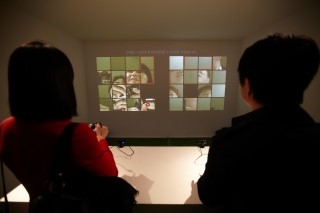
 Tacit Group       Face Puzzle

CrossDesign Lab       Stream

 Yeo Jin-wook       Bio-Sonar

 Octamin          Last Night on Earth

  Park Earl         Mr. Kongdak

 Bae Seong-hun       Catch Light

 Han Hee+Kim Kun ho      Voice Cello

  Kim Byung-kyu       Mood Board for Laser

Choi In Kyung          [blow:]


==============================================
 
 
<the Prototype for Commercialization, Open Call for Da Vinci Idea 2010>
 
 
Kim Dong-jo      Record of the Capsule 


Technology is pervasive in our society and infiltrates every corner of daily life. It is upgraded and enhanced daily, changing the horizon of our perception, aspects of our experience, and revolutionizing society’s physical and spiritual base. It has also brought revolutionary change to artistic creation systems, art’s role, function, and status, seen in photography and movies emerging in the 19th century, the TV and computer in the 20th century, and the Internet, mobile communication, and wireless networks. All these changes are accelerating.
 
Random Access Black Box, 2011 Da Vinci Idea Exhibition, succeeding the 2010 exhibition, The Return of Techné, explores easing the tension of distorted relations between art and technology, how to interweave artistic imagination and technological reality in the original sense of Techné, which means no distinction between the category of art and masterful dexterity and technology required in daily life. Futhermore, it presents the possibilities of an expansion as a practical dimension such as combination of technology, art and life, the convergence of them with business.
 
While The Return of Techné comprised diverse experiments in various mediums, from simple to cutting-edge technologies, Random Access Black Box has many installations with interactions between technology and users, works and viewers, media, space and the body, and also sound and lighting artworks enabling viewers to experience synesthetic stimulation.
 
Interesting experiments on display are based on precise composition and design enabled by new technologies inducing a variety of acceptance patterns of users. Paradoxically, advanced engineering technologies including digital programs used for the design of work are just black boxes users cannot interpret: Nobert Bolz (1953~ ), a German philosopher and media theorist refers to all technical mediums, which we everyday but do not understand, and the principles of their operations, as a black box.
 
Works on show stimulate perception and sensibilities and involve viewers in technology and design, exploring the form and fusion of mediums and user interfaces. Users can have intuitive commune with works without special knowledge of technology. They can become "random" producers who complete content and meaning through aggressive intervention without any special knowledge on engineering.
 
These works extend the realm of art through close combination with new media technology, internalizing modes of artistic production through mutual interactivity. Random Access Music(1963), a classic work by Nam June Paik (1932-2006), forerunner of media art, is a good example. In this work viewers join a process of generating sound by selecting a specific part of a cassette tape that is possible with a mp3 player today. Random access here connotes a way of existence common to all works in the Da Vinci Idea Exhibition.
 
As Paik conducted experiments through amalgamation of universal media and technology reflecting aspects of the times, Da Vinci Idea artists realize experience in reality with their imagination. A "bricolage" of technology and media, existence and imagination, cultural and artistic sensibility, and aesthetic values, wil lwork as a strategy enabling users to experience unfamiliar scenes through new perception and technological communion.


Kim Byung-kyu’s Laser Mood Board for laser as main medium represents an interaction between a laser’s rhythmical movement and space through its dynamic sensibility. This work offers perceptual experience of a situation created through interaction between rays of light and space, emphasizing a physicality made by the strong visual effect of a laser flickering and producing texts. The texts seem to offer specific information, in public context, but meaning is ambiguous within arrangements of fragmented words. The texts and the medium seem heterogeneous. This work made of adjectives excerpted from the Wikipedia definition of laser, such as ‘optical’, ‘stimulated’, ‘emitted’, and ‘diffraction-limited’ shows a structure in which a medium intermediates text, and text is reduced to a medium by using text defining the conveying medium. In this cyclical structure, the hybridism between a cognitive, aesthetic stimulus of the physicality of laser as sensuous object, and reading and interpreting the text as an epistemological object, resonates states in other aspects.


Bae Seong-hun’s Catch Light is similar to Mood Board for Laser as it conveys messages by adopting light and technologies, but brings about different emotion and experience. As its title indicates, this work demonstrates a lyric approach to technical equipment briefly capturing light. The core of this work featuring the afterimage of light and image extends the stay of light using luminescence material. This work captures the temporality of light from its creation to extinction, vividly appearing but gradually disappearing, leaving a poetic resonance.


At the exhibition are also works reinterpreting tradition with a modern flare in a continuation of, not severance from, the past, despite new technological mediums. HYBE’s Light Tree: Interactive Dan Flavin re-illuminates the minimalist fluorescent light tubes of Dan Flavin(1933-1996) from the 1960s, through digital technology. Experimenting with light and its effect, Flavin explored artistic meaning in relationships between light, situation, and environment. The readymade fluorescent light fixtures he used created space divided and adjusted by light and composition, offering a newly structured space with light. HYBE’s work expands the logic of Flavin by reinforcing the physical property of light through interactive media. It presents an escape from traditional lighting, as light and color changes when touched by viewers. Lighting here is divided into front and back, and colors are programmed to maintain complementary colors. The front lighting constantly interacts with colors on a back wall through visual contrast and mixture. A random change and diffusion of light with the involvement of viewers provokes tension extending and segmenting space, turning space into a forum for emotional perceptual experience.


Sound media expanding sound through a new interface and modifying it fill the Da Vinci Idea exhibition together with lighting artworks. Park Earl’s Mr. Kongdak offers sensuous perception of invisible entities by spreading sounds and vibrations of heart beats through speakers and woofers. A viewer becomes a producer and listener of their own sounds by hearing heartbeats through a robot with a built-in microphone. The sounds and vibrations from the body return to the body, through sound waves moving through air and sensory organs. The dynamic and pitch of heart beats from the viewer’s body through the robot is sound art without artificial sounds. This work enables viewers to commune with others by expanding private sounds and vibrations to a public space, and newly perceive life and existence through hearing and touch.


Sound can also create community despite its weaknesses and incompletenesses. Han Hee and Kim Kun-ho’s Voice Cello reveals a solidarity of sounds through a familiar sound medium, and an analytical approach to the generation and change of sound. This work adapts human songs to sounds of instruments and generates indigenous tones in instruments by using the pitch and dynamic of a human voice to convey equivalent vibrations through a Bluetooth transmitter-receiver. The interface offers perception of the memory and experience of sounds in diverse sound language.


Also using sound as his work’s significant element, Yeo Jin-wook’s Bio-Sonar overturns the general use of media by converting an output device like a speaker to an input unit, thereby presenting an unexpected quality. When a viewer approaches the work, expecting to hear certain sounds, the speaker generates sound and moves back and forth via the reaction of a sensor. The viewer feels unfamiliar when the speaker shows an unexpected response to his movement. If fully grasping the system, he willingly becomes an element actively operating the work.


Choi In-kyung’s [Blow:] is an attempt to breaking down the frame of familiar perception through media’s operating methods. This work transforms a microphone linked to loudspeakers to an interface reacting to the vibration of breath. As breath is of life, particles in a digital space gain vitality with a viewers’breath. This work weakens our rejection of cold machines through an emotional interface and delicate technology.

A relational situation of interaction between artworks and viewers shows various contexts when viewers are involved in "open works", such as Cross Design Lab’s Stream, Octamin’s Last Night on Earth, and Tacit Group’s Face Puzzle.


CrossDesign Lab’s Stream, composed of 800 acryl pixels, reflects a viewer like a mirror. A camera and sensor built in the center perceive an observer’s movement and silhouette, so the pixels give form to the observer in a real-time basis. The pixels are embodied into an object, replacing two-dimensional illusion with tactility. Despite the digital system perceiving the viewer, the interactive image stimulates analog emotion, exquisitely combined with a shadow dependant on lighting and visual angles, pixel texture, physical movement, and fricative sound.


Tacit Group’s Face Puzzle mainly engaging in audio-visual work is an interactive piece in the form of game. It shows two gamers putting puzzles together (4x4 tile puzzle) while seeing each other’s face, demonstrating a process of making variations of sound alongside images. The participants work as protagonists of the game, and random visual and sonic results are modified by different arrangements and combinations. The artist produced the draft of the game: Tacit Group only design the basic algorithm and propose the system. Those who generate the random incidents through involvement are the viewers as consumers and producers making images and sounds.

 
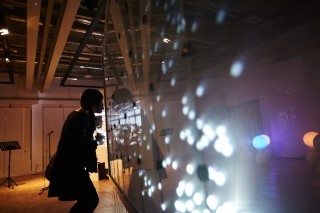
Octamin’s Last Night on Earth is a visual representation of "openness" allowing active viewer participation in completing the work. Appropriating a kaleidoscope’s visual structure, this work is a fantastic scene with mirrors on the four walls of a cube, and surreal, programmed interactive images responding to viewer silhouettes and movement. Viewers here are determinant mediators producing variable images. The images infinitely proliferate when reflected on mirrors, adding irregular attributes and contingency. This work also reinforces aesthetic fantasies, blurring the boundary between imagination and reality, exquisitely blending the real viewers placed in the inside of the kaleidoscope, the viewers reproduced through mirrors, and an illusory space in mirrored space.
 
 
_ Jung ah Lee(Art History)
The Question Concerning 'We' Human and Technology - The Politics of doubleness of Human-Technology Collaborative Action
 
 
Cho Hyun-kyoung
_Post-doctoral Researcher, ASPECT[1],
Virginia Polytechnic Institute and State University
 
 
Enlightenment asks enlightenment. Truth is Circe’s poison. [2] Can the poison that transformed man into swine change the swine into man? Enlightenment that answers ‘yes’ or ‘no’ is a fraud. The quintessence of enlightenment is in the events in which firm belief in the universality of spirit and science, ensuring this solidly, becomes suddenly fluid, evaporating into air.[3]
 
  [Figure 1] Circe and her Swine [4]
 
The interventions between and consilience of technology, man, and industry might be part of the Enlightenment. The question here is, “Does the industrialization of technology-based contemporary art contribute to an aestheticization of capitalist politics, or politicization of capitalist art? ”
 
In other words, if Geumcheon Arts Factory’s Da Vinci Project questions enlightenment within enlightenment, is cutting-edge technology-art with commodity value in exhibition a business skill, dedicated to improving capitalistic productivity from an instrumental perspective? Or is this a new way of knowing the enlightening nature of spirit?
 

The collaborative action of ‘We’ human and Technology

Technology more than represents human thought and action. A computer with high intelligence and sensibility can think and act like man. Computational technology such as Artificial intelligence (AI) and Artificial Life (AL) programmed by genetic/evolutionary algorithms has its own law in terms that the system itself evolves. With an indigenous principle it performs autonomous and emergent actions; it solves problems man cannot, and creates the optimization unexpected by programmer. In particular, HCI (Human-Computer Interaction/Interface) techniques focus on the commercial and instrumental aspect of computer responding to human action.
 
The technological condition today is that technology does not a mere tool (instrument). It naturally reacts to human actions, or even leads them. Technology and man here are a pair of dancers performing on stage; collaborators sharing an objective and process; two performers in equality. When man and technology communicate through collaborative action, as in a relationship between humans, they become ‘we’, in a multi-dimension network, beyond ‘I’ of a one-dimensional relationship.
 
Technology-based contemporary art intervenes in issues beyond the inner problem of art. It problematizes knowledge-power relations that underlines a free relationship of ‘We’ human and technology in instrumental perspective.
 
In The Question Concerning Technology, Martin Heidegger states that the instrumental understanding of technology is rooted in the human-subject centered dichotomy. It leads us to the final delusion, the reification of human subject” to the point where “it seems as though man everywhere and always encounters only himself," [5]
 
The binary frame forces a rule/idea-based context-independent perspective. It subordinates both ‘We’ human and technology into the instrument. The subordinate moment is “Enframing (Gestell),” as Heidegger’s conception. [6]  Enframing indicates that the collaboration of ‘We’ human and technology is enframed as a part of stockpile of available materials and personnel, and always ready for instrumental purpose. It thrusts ‘We’ human and technology into the ordering, setting-upon and challenging nature, that is, busy instrumental circumstances. The human condition is shaped by the provocative exigencies of instrumental planning and control. Heidegger thus says that the binary frame is culmination of modern thinking. It is the human’s hubris.

 
Doubleness

Through criticism of the problematic of instrumental perspective, technology-based contemporary art reminds us of the importance of an action-based context-independent perspective, imprinting the politics of collaborative action of humans and technology.[7]
  
Heidegger argues technology is not technology, and knowing or understanding technology as a tool covers the essence of our relations; essence as a way that enables humans to be with technology, that makes ‘we’ remain ‘we.’ In terms of Heidegger’s ontology, truth is ‘the correctness of an idea’ executed by revealing. Here, technology becomes ‘the mode of revealing’ the presence of truth. Technology as mode of revealing connotes change compromising human conditions, promising the opening of truth by revealing concealed essence.  
 
Revealing by technology is dualistic. Technology tries to oust nature, and exhaust its energy. Man, technology, and nature are incorporated into an order of ‘challenging’, and the essence of relations is concealed here. Paradoxically, concealing by technology makes us reflect on our relations. This revealing is thus a sort of evocation, presupposing reflection and reconsideration. Sherry Turkle captures the doubleness of technology in our relations.[8] ‘The computer is our emotional, intellectual friend. This friend draws out our memories, and has us look back on our relations. This triggers new ideas.’
   
Concealing and revealing. When we look at the doubleness technology has, we can understand Heidegger’s aporetic ontology. An instrumental understanding of technology is not wrong but is not yet truth. The essence of technology is here and now, where the concealed meets the revealed. Duality in the essence of technology teaches us this. As technology is never free from value or judgment (a perspective for understanding), it is not neutral. The definition of technology is not based on any given rule/idea but changes in each situation or context. This is the social, cultural, and political dimension of technology.
   
The politics of collaborative action between technology and man is due to this doubleness of technology.[9] If we follow Heidegger’s perspective, human existence is the encounters of beings, and a correspondence between beings is the condition of human presence. It is Interesting here that the encountering of beings and the condition has already connoted technology. Inasmuch as technology is a mode revealing the truth of the human condition, we are originally social beings, and the whole of each existence can not be constructed by only humans or instruments. The politics of collaborative action between technology and man derives from this. 
 
The political power of doubleness derives from established knowledge-power relations.[10] The collaborative action brings the instrumental perspective that subordinates both ‘We’ human and technology into instruments of capitalist production. The instrumental perspective concentrating on human-subject-thought is a rule-based, context-independent perspective overlooking action and experience. This perspective confines technology as an instrument ignoring ‘our’ relations.
 
That is to say, the collaborative action of ‘We’ human and technology is nothing but a reserved material or useable tool from the instrumental perspective. Its value is judged by the principle of efficiency (fixed rule and a measure for productivity).
 
Reification of man and technology is Enframing from the instrumental perspective. As this is the delusion of man, what we have to be wary of and overcome is not technology itself but a false consciousness of technology.[11] In this sense we allow a reversal of Heidegger’s Enframing. Saving power beyond Enframing from the instrumental perspective is innate in this danger.
 
Technology-based contemporary art is not the result of an individual artist’s creativity and genius but the remnants of man and technology. It is attained through the execution of collaborative action between ‘We’ human and Technology. The work cannot exist without the collaborative action. This new situation breaks down the established arts of artists and viewers, and ways of knowing. Cutting-edge technology-based art becomes a new knowing beyond the arena of knowing at this point.
 
Consequently, technology-based contemporary art created through the collaborative action of ‘We’ human and technology remembers the secret of art already mentioned in Holdrline’s poem before Heidegger. It grasps one point where danger and saving power meet, thereby questioning the aesthetic, social, ethical, cultural, and political connotations of the changed human condition through the collaborative action of ‘We’ human and technology. This question leads to new ways of knowing. The reversibility of instrumental perspective may change the scale and degree of the questions that cutting-edge technology-based works of art raise. To notice danger with a clearer eye, we must once more question concerning collaboration of ‘We’ human and technology.
 
When technology-based contemporary art senses the politics of the collaborative action of ‘We’ human and technology and when art reacts to social, cultural demands, breaking away from its internal issues, we are readily able to embrace optimism in Heidegger’s ontology. As long as art keeps addressing the problem of ‘we’ not ‘I’, and captures the moment of pre-existing agitating knowing and ways of knowing given one-sidedly, truth is surely sensed in any circumstance.
 
                                                         
[1] Post Doc. Researcher. ASPECT (Alliance for Social, Political, Ethical, and Cultural Thought) is an institution of academic federation among researchers in different disciplines, and program for a doctoral study.
 
[2] Friedrich Wilhelm Nietzsche, Human, All Too Human (Cambridge: Cambridge University Press, 1996) p.182.
 
[3] Max Horkheimer and Theodor W. Adorno, Dialectic of Enlightenment (California, Stanford: Stanford University Press, 2002)
 
[4] Circe and her Swine (1871) by Briton Riviere (1840-1920), Hand-printed etching, 53 x 84 cm,
 
Manchester Art Gallery.
 
[5] Martin Heidegger, The Question Concerning Technology and Other Essays (New York: Harper & Row, Publishers, Inc., 1977) 27.
 
[6] Heidegger, Ibid., 19.
 
[7] The point of this essay, a criticism of and distinction between the rule-based and experience-based behavior, and context-dependent and independent-perspective, is applied with the Dreyfus Model, formalized by Hubert and Stuart Dreyfus for the phenomenological analysis of human learning. Hubert and Stuart Dreyfus, Mind and Machine: The Power of Human Intuition and Experience in the Era of the Computer (New York: Free Press, 1986). On the methodology of natural science and social science for this analysis, refer to Bent Flyvbjerg, Making Social Science Matter: Why Social Inquiry Fails and How It Can Succeed Again (Cambridge: Cambridge University Press, 2001)
 
[8] Sherry Turkle, Evocative Objects: Things We Think With (Cambridge: The MIP Press, 2007), and The Second Self: Computers and the Human Spirit (New York: Simon & Schuster, 1984) pp.64-92.
 
[9] The doubleness of the collaborative action between technology and human was first discussed in Hyunkyoung Cho and Joonsung Yoon, Performative Art: The Politics of Doubleness, Leonardo, Vol.42, Issue 3 (Cambridge MIT Press, 2009). On the politics of collaborative action between technology and man, refer to The Politics of Collaborative Action of Technology and human, Proceedings of HCI Internatoinal 2011 (Verlag Berlin Heidelberg: Springer, 2011), pp.199-208.
 
[10] The terms ‘knowing’ and ‘knowledge-power relations’ were appropriated from Michel Foucault. What we usually call knowledge is ‘knowing’ from Foucault’s perspective. ‘Knowing’ is the object of knowledge, and at the same time a sort of execution including the action and result of knowing. Knowing is thus power, or a ‘knowledge-power relation’.
 
[11] The concept of Enframing Heidegger uses to criticize the instrumental perspective has the same origin as the inversion of consciousness Karl Marx points out. The delusion of Enframing is inversion as an illusion of consciousness taking place when use value is converted into exchange value. Hyunkyoung Cho and Joonsung Yoon, Illusion of Technology in Human-Computer Interactive Art, Proceedings of ISEA 2008, pp.109-110.
 
 
The Problem and Prospect of the Fusion of Technology and Other Industries through Artistic Practice
 
 
Choi Byoung-il
_ Associate Professor, Visual Communication Design Major,
 College of Art & Design, Konkuk University
 
 
We usually imagine a typical artist standing before a canvas on an easel looking serious, wearing an apron smeared with paint, holding a palette in one hand and a brush in the other. Applying this to a media artist is somewhat awkward and incongruous as he deals with different media. However, we need to rethink that this awkwardness is caused by only the media.
 
Technology-based or new media art differs from conventional art forms in that work is possible without perfect understanding or competent use of technology, and involves other fields of art. For example, if an artist wants to produce work with a flower reacting to sound, he recounts his idea to an engineer or programmer and has them to make this idea into a work. The engineer looks for a sensor and positions it correctly; the programmer makes an algorithm to read the signal from the sensor. A modeler can then make the physical work based on a sketch by the artist. In conventional art, for which technology was rarely used, there is little need to involve engineers, programmers, and modelers. In conventional art practice artists are able to collaborate only with their assistants or their best pupils.
 
New media artworks including conception and production can be made through a combination of different fields. The working method of new media art can combine industries, and the process is similar to that of industrial production. It is unnecessary for an artist to engage in the whole processes of work from beginning to end to embody his idea, and mass production is possible by using industrial production. Such processes were not part of an artistic act in conventional art-working, and an artist could not have a link with an artwork through this process.
 
How do we see separation between work conception and work production? Does anyone produce media work if he has an idea and time? Are the artist and the producer co-owners of the work?
 
I have collaborated with programmers, electricians, and control engineers to produce my work. In this process I thought of the above questions, and could answer them ambiguously. I think it is really necessary to separate work conception from work making. In media work, operation is as important as concept. The success and failure of operation is profoundly influenced by the help of each field’s experts. Expert advice may shorten the time it takes to turn out artworks, and can realize an artist’s intention more easily.
 
The answer to the second question, “Can anyone do media work?” is “No.” It is not an arrogant attitude as an artist. Any media artist has to consider and understand technology. I think anyone can and should do media work if he or she fully understands technology and wants to make media work using technology. As to the last question, I think media work made by an engineer at the request of an artist who offered a concept and idea is not in joint possession. As engineers often reply to what I demand, based on their expertise, without considering the context of my work, their help is insignificant or fragmentary in many cases. If an engineer explores solutions aggressively with a concern for the work itself, work may rely too much on technical experiment, deviating from my original intention.
 
There were two types of collaborative work: collaboration with a new-media artist with remarkable ability in programming and collaboration with a professional programmer. In the former case the process of working together was very smooth because the artist knew all my previous work and understood the context of my newly conceived work. When I explained what I wanted, he did what I really wanted. In the latter case I showed an expert programmer an operation scenario and flowchart I had conceived. The programmer produced a program based on this. After using the program I made notes of its problems, made a list of points to be added or modified, and sent them to the programmer. The programmer sent the program back to me after modifying the source codes. I got satisfactory results after repeating this process.
 
Another case I consider is when a designer or an artist works in cooperation with experts in other fields. The former is an ideal condition all practitioners want. A collaborator understands the entire context of work, and knows exactly what he has to do. There is little room for problems, but it is a condition hard to anticipate in reality. Most works are executed under the latter case. Lots of problems and complaints arise among designers, artists, and experts in other areas. In my case there was no problem since what I wanted was simple and clear. However, there may be various complaints derived from the gap of opinions between the artist who works only with monitors and one who addresses real objects. Also diverse troubles can arise between an artist who lacks an understanding of a specific field and presents a vague direction and the producer who wants something obvious.
 
I think most of problems derive from the artist. That is why the artist often becomes unreasonable in his demands or makes an indefinite decision based on no knowledge of necessary fields or a lack of understanding. Some experts ask artists to rectify details for their convenience. In some cases however, joint is terminated in the middle because some artist is unreasonable in his demands, wanting his ideas embodied perfectly.
 
The solution to this problem is to understand each other well, but it is not as easy as we think. An artist has to assume the role of a supervisor, but lacks an actual understanding of the technology. A technician has sufficient knowledge of technology, but cannot or refuses to understand the context of the work. When I make some suggestion, an engineer puts more importance on the technology’s level of difficulty than the work’s meaning and intention. When I meet and talk with engineers or experts in other areas for work, the question I was most frequently asked is “Why are you doing this?” That is why the engineers consider what I think is necessary, unnecessary. By contrast, artists react similarly to what engineers consider necessary.
 
While creating work, I think more about the problems that may arise in the process of collaboration than the work itself, which is not so productive. I try to solve all everything myself, but have to know so many things beyond the work to do this, and even undergo a reduction of my work idea in some cases. This is like a baseball player running for basic physical strength to become an athlete.
 
Repeating this process several times, I start to feel like a coordinator. A coordinator is neither an artist nor an engineer. He is someone who understands the artist’s intention well, and can give technical advice. As the coordinator has working knowledge of engineering, he can review which field of technology an artist wants is suitable, which disciplines have to be combined, what concrete practical methods are best for the artist’s intention, and how the artist contacts those who provide aid. This coordinator’s role is of great significance in the process of mass-producing the artist’s work.
 
Another way is to produce a prototype of an artist’s work professionally. Under this system, one consults with an artist, and selects materials, considering mass production from an early stage in work design. Although it is really hard to find a proper person for this role, I think this person is really needed in media art.
 
Is there no problem if an artist only conceives work and there is a proper coordinator? One sees that language is not the source of intellectual growth but is merely its byproduct. By contrast, some see that language plays a significant role in cognitive development, and forms the core of an infant’s spiritual function. Thinking evolves through the tool of language.
 
In conceiving work requiring diverse technologies beyond an artist’s expertise, the artist should not forget that technology itself is not a simple means produce work processes but an element to be grasped and internalized before executing work. However, technology is just used as a simple tool in many media artworks. Technology here becomes part of a sensational magic show. Only marvelous, novel technology is used in some exhibitions of interactive artworks that seek amusement rather than the expression of an artist’s idea and intention. With this, the art world is critical of media art. It is very important to understand our thoughts expanding through the vehicle of technology and media art with determined ideas on this.


Kim Byung-kyu _ Mood Board for Laser


Park Earl _ Mr. Kongdak


Bae Seong-hun _ Catch Light


Yeo Jin-wook _ Bio Sonar


Octamin _  Last Night on Earth


Choi In-kyung _ [Blow:]


Tacit Group _ Face Puzzle


HYBE _ Light Tree : Interactive Dan Flavin


CrossDesign Lab _ Stream


Han Hee + Kim Kun-ho _ Voice Cello


The prototype for Commercialization, Open Call for Da Vinci Idea 2010
Kim Dong-jo _ Record of the Capsule